December 28, 2025

PUBLIC IMAGE AS ART
By Logan Royce Beitman
Show at Monroe Gallery shows how pre-social media artists immortalized themselves through photography
SANTA FE — I bet you can picture Pablo Picasso — bald head, striped boating shirt — but not fellow cubists Georges Braques or Juan Gris. You can probably identify pop artist Andy Warhol’s signature silver wig and black turtleneck, but what did Roy Lichtenstein and James Rosenquist look like? When it comes to the surrealists, more people recognize Salvador Dalí, who was kicked out of the movement, than André Breton, who founded it.
What did Picasso, Warhol and Dalí have in common? Besides being artists, they were celebrities — household names whose fame extended far beyond the artworld. Their media-ready personas and larger-than-life antics played into stereotypes of what people expected artists to look and act like. Picasso — part of the original European avant-garde — fancied himself a Bohemian bullfighter against mainstream society. Warhol was a Bohemian, too, with his ever-present coterie of disaffected “superstars,” but, in contrast to Picasso’s tempestuousness, Warhol was the quintessence of cool, speaking only in irony-soaked monosyllables. Dalí, for his part, played “the crazy artist,” saying outrageous things like, “I don’t do drugs; I am drugs,” and bringing a live anteater onto “The Dick Cavett Show.”
“Artists Behind the Art” at Monroe Gallery presents photographic portraits of artists — these and others. Some shots are posed, some are candid and some, purporting to show the artists at work, lie somewhere in between, with the artists enacting their signature gestures for the camera. Seeing so many photographs of artists in one room got me thinking about how photography contributed to the mythologization of many 20th century artists.
In the 19th century, even after the invention of photography, few artists turned the camera on themselves or cultivated media-ready personas. Artists like Gustave Courbet and Edgar Degas used photography mainly as a preparatory aid for their paintings, a way of capturing reality more quickly and accurately than ketching. The 21st century saw the democratization of celebrity through the internet and social media, and now anyone with a smartphone can turn themselves into a brand.
But between the 19th century, when photography was new, and the 21st, when it is everywhere, photo portraitists of the 20th century helped artists turn their faces into icons and their lives into legends.
Steve Schapiro photographed the surrealist painter Rene Magritte for LIFE magazine in 1965 at a time when the magazine reached nearly a quarter of the U.S. population.

The setting is Magritte’s retrospective at the Museum of Modern Art in New York City. Magritte and Schapiro collaborated on the shoot, brainstorming creative poses that would erase the distinction between artist and art. In one, Magritte, wearing his signature bowler hat, stands in front of “Golconda,” a painting that shows scores of men in identical hats levitating heavenward.
By cropping out the painting’s frame, shooting from a slight upward angle and using a fairly shallow depth of field that keeps the painter’s face in focus while fuzzing-out the brushstrokes, Schapiro makes it appear as though Magritte has stepped through a looking glass into the image-world of the painting.
Men around him are floating away, and he may lift off, too, at any second. In another photograph from the series, Magritte rests on a museum bench, using his bowler hat as a pillow, and “dreams” the painting behind him. Schapiro’s photographs of Magritte interacting with the paintings blur the line between reality and fiction even better than the paintings do.
The following year, Schapiro photographed Warhol in front of his “Cow Wallpaper” at the Leo Castelli Gallery. Giant pink cow heads covered the walls of the gallery’s main room, while the artist’s helium-filled “Silver Clouds” floated aimlessly in an adjoining room. The exhibition, which Warhol announced in interviews as his “farewell to painting,” paved the way for the Instagrammable, Meow Wolfstyle immersive art experiences of today. In the photo, Warhol crosses his arms and holds his left hand to his face in an oddly stylized gesture, his middle finger pressing his lip into a slight smirk. This is the image of a deadpan artist-provocateur, whose ironic self-presentation was inseparable from his art.
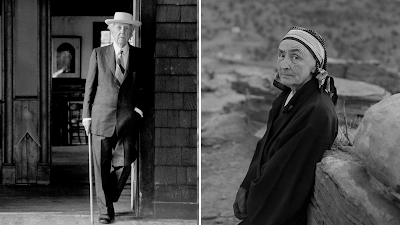
Schapiro has seven images in the Monroe Gallery show, while Tony Vaccaro has the most at 17. Vaccaro’s images of Georgia O’Keeffe, taken in New Mexico in 1960, reveal multiple sides of the artist. In one, O’Keeffe, standing in the desert, lifts a red and yellow “Pelvis” painting onto an easel.
The left edge of the painting nearly touches that of the photograph, and the precision of the alignment reflects O’Keeffe’s perfectionism. Visitors wishing to see that particular painting in the flesh, by the way, can walk just a few blocks to the Georgia O’Keeffe Museum, where it currently hangs in the “Tewa Nangeh” exhibition. In another of Vaccaro’s photographs, O’Keeffe, riding in the backseat of a car, holds a piece of Swiss cheese to her eye. The oblong hole in the cheese mirrors the hole in the painted pelvis bone.
But if the first image makes the artist look serious, the second undercuts the O’Keeffe myth, showing her to be self-effacing and silly. But which image is more accurate?
Martha Holmes’ 1949 photographs of Jackson Pollock depict the artist dribbling paint across an unstretched canvas on his studio floor while a cigarette dangles from his lips. These widely reproduced photographs of Pollock, along with Hans Namuth’s from 1950, helped inspire the art critic Harold Rosenberg to rechristen the abstract expressionist movement “action painting” in his influential 1952 essay, “The American Action Painters,” reframing the painters’ processes, not as compositional strategies, but as dance-like physical improvisations.

Ernst Haas’ photographs of Helen Frankenthaler pouring buckets of paint onto her canvases are not as well known as Holmes’ photographs of Pollock, but they should be. The one in this show has a vertical orientation, which emphasizes the weight of the falling paint and its relationship to the artist’s body, and to gravity.

Many young artists around the world, seeing photographs like these of Frankenthaler and Pollock, came to consider the performative quality of “action painting” more important than the finished work. The result was a proliferation of performance art in the 1960s and ’70s: Gutai, Fluxus, happenings, body art, process art, the Viennese Actionists and so on.
Lucien Clergue’s portrait of Salvador Dalí from 1969 — a straight headshot — is one of the least theatrical images of Dalí I’ve ever seen. Dalí frequently collaborated with the Latvianborn photographer Philippe Halsman on outrageous artist portraits, including “Dalí Atomicus” (1948), depicting the artist leaping through the air, paintbrush in hand, alongside three live cats and a bucket of water. Clergue’s close-up headshot, taken two decades later, is the antithesis of that. Where Halsman created superhuman fictions, Clergue shows us Dalí’s tired eyes, rumpled hair and five-o’clock shadow — in other words, his human frailty.
The only 21st-century work in the show is Gabriela E. Campos’ photograph of Judy Chicago from 2023. The artist poses behind one of her “Moving Parts” sculptures — clear acrylic forms, similar to chess pieces, which rest on a translucent pink acrylic base.
Although the artist has been artificially posed, the portrait reveals truths about her work, including the centrality of color and the intrinsic relationship between her sculptural forms and her body.
Alexander Calder, Annie Leibovitz, Gordon Parks, Francis Bacon and Joan Miró are among the many artists whose portraits appear in “Artists Behind the Art.”
Vaccaro has two eye-catching photographs of the art collector Peggy Guggenheim, as well. In one, she wears a flamboyant pair of sunglasses as she floats down a Venetian canal.

Guggenheim’s public image was as bold and memorable as those of the artists whose work she collected.
The artists in “Artists Behind the Art” rarely reveal their inner lives to us. More often, they show their canniness for curated self-presentation. Such branding tactics, now ubiquitous among social media users, are ones they perfected in close collaboration with their savvy photographic portraitists. In the best of these photographs, the artists become the art. Today, millions of ordinary people do the same.
Logan Royce Beitmen is an arts writer for the Albuquerque Journal. He covers music, visual arts, books and more. You can reach him at lbeitmen@abqjournal. com.