Showing posts with label artists. Show all posts

Sunday, December 28, 2025

Show at Monroe Gallery shows how pre-social media artists immortalized themselves through photography

 Via The Albuquerque Journal

December 28, 2025

color photograph of artist Andy Warhol posing in front of "Cow Walpaper" in the Leo Castelli Gallery in NY,  1966
Steve Schapiro: Andy Warhol, Cow Wallpaper, Leo Castelli Gallery, New York, 1966


PUBLIC IMAGE AS ART

By Logan Royce Beitman

Show at Monroe Gallery shows how pre-social media artists immortalized themselves through photography

SANTA FE — I bet you can picture Pablo Picasso — bald head, striped boating shirt — but not fellow cubists Georges Braques or Juan Gris. You can probably identify pop artist Andy Warhol’s signature silver wig and black turtleneck, but what did Roy Lichtenstein and James Rosenquist look like? When it comes to the surrealists, more people recognize Salvador Dalí, who was kicked out of the movement, than André Breton, who founded it.

What did Picasso, Warhol and Dalí have in common? Besides being artists, they were celebrities — household names whose fame extended far beyond the artworld. Their media-ready personas and larger-than-life antics played into stereotypes of what people expected artists to look and act like. Picasso — part of the original European avant-garde — fancied himself a Bohemian bullfighter against mainstream society. Warhol was a Bohemian, too, with his ever-present coterie of disaffected “superstars,” but, in contrast to Picasso’s tempestuousness, Warhol was the quintessence of cool, speaking only in irony-soaked monosyllables. Dalí, for his part, played “the crazy artist,” saying outrageous things like, “I don’t do drugs; I am drugs,” and bringing a live anteater onto “The Dick Cavett Show.”

“Artists Behind the Art” at Monroe Gallery presents photographic portraits of artists — these and others. Some shots are posed, some are candid and some, purporting to show the artists at work, lie somewhere in between, with the artists enacting their signature gestures for the camera. Seeing so many photographs of artists in one room got me thinking about how photography contributed to the mythologization of many 20th century artists.

In the 19th century, even after the invention of photography, few artists turned the camera on themselves or cultivated media-ready personas. Artists like Gustave Courbet and Edgar Degas used photography mainly as a preparatory aid for their paintings, a way of capturing reality more quickly and accurately than ketching. The 21st century saw the democratization of celebrity through the internet and social media, and now anyone with a smartphone can turn themselves into a brand.

But between the 19th century, when photography was new, and the 21st, when it is everywhere, photo portraitists of the 20th century helped artists turn their faces into icons and their lives into legends.

Steve Schapiro photographed the surrealist painter Rene Magritte for LIFE magazine in 1965 at a time when the magazine reached nearly a quarter of the U.S. population.


black nd white photograph of the artist Rene Magritte sleeping on a bench in front of one of his paintings at MoMA in New York
Steve Schapiro: Rene Magritte at MOMA., 1965


The setting is Magritte’s retrospective at the Museum of Modern Art in New York City. Magritte and Schapiro collaborated on the shoot, brainstorming creative poses that would erase the distinction between artist and art. In one, Magritte, wearing his signature bowler hat, stands in front of “Golconda,” a painting that shows scores of men in identical hats levitating heavenward.

By cropping out the painting’s frame, shooting from a slight upward angle and using a fairly shallow depth of field that keeps the painter’s face in focus while fuzzing-out the brushstrokes, Schapiro makes it appear as though Magritte has stepped through a looking glass into the image-world of the painting.

Men around him are floating away, and he may lift off, too, at any second. In another photograph from the series, Magritte rests on a museum bench, using his bowler hat as a pillow, and “dreams” the painting behind him. Schapiro’s photographs of Magritte interacting with the paintings blur the line between reality and fiction even better than the paintings do.

The following year, Schapiro photographed Warhol in front of his “Cow Wallpaper” at the Leo Castelli Gallery. Giant pink cow heads covered the walls of the gallery’s main room, while the artist’s helium-filled “Silver Clouds” floated aimlessly in an adjoining room. The exhibition, which Warhol announced in interviews as his “farewell to painting,” paved the way for the Instagrammable, Meow Wolfstyle immersive art experiences of today. In the photo, Warhol crosses his arms and holds his left hand to his face in an oddly stylized gesture, his middle finger pressing his lip into a slight smirk. This is the image of a deadpan artist-provocateur, whose ironic self-presentation was inseparable from his art.

Schapiro has seven images in the Monroe Gallery show, while Tony Vaccaro has the most at 17. Vaccaro’s images of Georgia O’Keeffe, taken in New Mexico in 1960, reveal multiple sides of the artist. In one, O’Keeffe, standing in the desert, lifts a red and yellow “Pelvis” painting onto an easel.

The left edge of the painting nearly touches that of the photograph, and the precision of the alignment reflects O’Keeffe’s perfectionism. Visitors wishing to see that particular painting in the flesh, by the way, can walk just a few blocks to the Georgia O’Keeffe Museum, where it currently hangs in the “Tewa Nangeh” exhibition. In another of Vaccaro’s photographs, O’Keeffe, riding in the backseat of a car, holds a piece of Swiss cheese to her eye. The oblong hole in the cheese mirrors the hole in the painted pelvis bone.

But if the first image makes the artist look serious, the second undercuts the O’Keeffe myth, showing her to be self-effacing and silly. But which image is more accurate?

Martha Holmes’ 1949 photographs of Jackson Pollock depict the artist dribbling paint across an unstretched canvas on his studio floor while a cigarette dangles from his lips. These widely reproduced photographs of Pollock, along with Hans Namuth’s from 1950, helped inspire the art critic Harold Rosenberg to rechristen the abstract expressionist movement “action painting” in his influential 1952 essay, “The American Action Painters,” reframing the painters’ processes, not as compositional strategies, but as dance-like physical improvisations.


black and white photograph of artists Jackson Pollock dripping paint onto a canvas on the floor of his studio in 1949
Martha Holmes/Life Picture Collection
Jackson Pollock painting in his studio, Springs, New York, 1949


Ernst Haas’ photographs of Helen Frankenthaler pouring buckets of paint onto her canvases are not as well known as Holmes’ photographs of Pollock, but they should be. The one in this show has a vertical orientation, which emphasizes the weight of the falling paint and its relationship to the artist’s body, and to gravity.

black and white photograph of artist Helen Frankenthaler pouring paint onto a canvas in her studio in NY in 1969
Ernst Haas: Helen Frankenthaler, NY, 1969

Many young artists around the world, seeing photographs like these of Frankenthaler and Pollock, came to consider the performative quality of “action painting” more important than the finished work. The result was a proliferation of performance art in the 1960s and ’70s: Gutai, Fluxus, happenings, body art, process art, the Viennese Actionists and so on.

Lucien Clergue’s portrait of Salvador Dalí from 1969 — a straight headshot — is one of the least theatrical images of Dalí I’ve ever seen. Dalí frequently collaborated with the Latvianborn photographer Philippe Halsman on outrageous artist portraits, including “Dalí Atomicus” (1948), depicting the artist leaping through the air, paintbrush in hand, alongside three live cats and a bucket of water. Clergue’s close-up headshot, taken two decades later, is the antithesis of that. Where Halsman created superhuman fictions, Clergue shows us Dalí’s tired eyes, rumpled hair and five-o’clock shadow — in other words, his human frailty.

The only 21st-century work in the show is Gabriela E. Campos’ photograph of Judy Chicago from 2023. The artist poses behind one of her “Moving Parts” sculptures — clear acrylic forms, similar to chess pieces, which rest on a translucent pink acrylic base.

Chicago’s clear blue eyeglasses and mint green sweater are reflected in the shiny, bubblegum-pink sculpture.

Although the artist has been artificially posed, the portrait reveals truths about her work, including the centrality of color and the intrinsic relationship between her sculptural forms and her body.

Alexander Calder, Annie Leibovitz, Gordon Parks, Francis Bacon and Joan Miró are among the many artists whose portraits appear in “Artists Behind the Art.”

Vaccaro has two eye-catching photographs of the art collector Peggy Guggenheim, as well. In one, she wears a flamboyant pair of sunglasses as she floats down a Venetian canal.


color photograph of Peggy Guggenheim in a blue cape in a Gondola, Venice, 1966
Tony Vaccaro: Peggy Guggenheim, Venice, 1966


Guggenheim’s public image was as bold and memorable as those of the artists whose work she collected.

The artists in “Artists Behind the Art” rarely reveal their inner lives to us. More often, they show their canniness for curated self-presentation. Such branding tactics, now ubiquitous among social media users, are ones they perfected in close collaboration with their savvy photographic portraitists. In the best of these photographs, the artists become the art. Today, millions of ordinary people do the same.


Logan Royce Beitmen is an arts writer for the Albuquerque Journal. He covers music, visual arts, books and more. You can reach him at lbeitmen@abqjournal. com.


Friday, December 26, 2025

Photographers Behind the Artists - Screening of New Documentary "Steve Schapiro Being Everywhwere"

December 26, 2025

Via Pasatiempo

black and white photograph of artist Rene Magritte in bowler hat and suit and tie standing in front of one of his paintings in the Museum of Modern Art in New York
Steve Schapiro:  Rene Magritte, MOMA, New York, 1965

EXHIBITIONISM


Photographers Behind the Artists


While we admire the work of famed and influential artists of our time, we don’t often see images of the artists themselves. The Monroe Gallery’s Artists Behind the Art exhibition gives the viewer a peek at the people behind some of the 20th century’s most iconic works, including Picasso (1881-1973), Willem de Kooning (1904-1997), Man Ray (1890-1976), Henri Matisse (1869-1954), and many more, as seen through the eyes of a select group of photographers who were granted access to the studios and work spaces, galleries, and candid moments of the artists in their elements.

On such photographer is Steve Schapiro (1934-2022), whose work is part of the exhibition and who didn’t just capture high-profile artists and celebrities in his portfolio, he also bore witness to significant moments in American and civil rights history, a particular focus of his.

Some of those images are part of the exhibition, and in addition, the gallery is hosting two special screenings of the new documentary Steve Schapiro: Being Everywhere at Sky Cinemas on Monday, December 29, and Tuesday, December 30. Both screenings will be followed by a Q&A with filmmaker Maura Smith, moderated by Michelle and Sid of Monroe Gallery. — B.S.

Artists Behind the Art; Through January 25, 2026, Monroe Gallery of Photography, 112 Don Gaspar; 505-992-0800; monroegallery.com

Steve Schapiro: Being Everywhere; 7 p.m. Monday, December 29, and 5 p.m. Tuesday, December 30; Sky Cinemas, 1606 Alcaldesa Street; $16; 505-216-5678; santafe.violetcrown.com

Wednesday, December 3, 2025

STEVE SCHAPIRO: BEING EVERYWHERE SCREENING IN SANTA FE

 STEVE SCHAPIRO: BEING EVERYWHERE

DEC 29 & 30 · FILMMAKER Q&A


Over six decades, photographer Steve Schapiro bore witness to some of the most significant social and cultural moments in modern American history.

Monroe Gallery represents Schapiro’s historic photographs, and several are featured in the current “Artists Behind The Art” exhibition.

Shot shortly before his passing by filmmaker Maura Smith, Steve Schapiro: Being Everywhere is a loving tribute to a man who was the quintessential "fly on the wall," waiting for moments to unfold and capturing them with a naturalism and skill that's nothing short of dazzling.

Sky Cinemas    (505) 216-5678

1606 Alcaldesa St. Santa Fe, NM 87501

Monday, December 29 7 PM

Tuesday, December 30  5PM


Promotional poster graphic for new documentary fild Steve Schapiro: Being Everywhere with images from film above a white couch


Sunday, November 23, 2025

New Exhibition: Artists behind The Art

color photograph of artists Alexander Caler in a red shirt standing with one of his mobiles in France, 1957
Tony Vaccaro: Alexander Calder, France, 1957


Monroe Gallery of Photography announces a new exhibit “Artists Behind The Art”. The exhibition opens with a public reception Friday, November 28 from 5 – 7 pm, and you can kick off the Holiday Season at the Holiday Plaza Lighting!

The exhibit continues through January 25, 2026.

Many of the most influential artists of the past century are, in a sense, unseen. This exhibition shows us the human beings behind some of the 20th century's most vital works of art. The photographs range from posed, candid, and working shots to behind the scenes of artists at work. In these photographs the essential personality of the artist is revealed, and an image of the past becomes visual history.

Artists depicted in the exhibit include Richard Avedon, Francis Bacon, Alexander Calder, Judy Chicago, Willem De Kooning, Helen Frankenthaler, Rene Magritte, Henri Matisse, Henry Moore, Pablo Picasso, Jackson Pollock, Georgia O’Keeffe, Andy Warhol, Andrew Wyeth, and many more.

View the exhibition here.


Friday, November 21, 2025

Fall Of Freedom


Fall of Freedom is an urgent call to the arts community to unite in defiance of authoritarian forces sweeping the nation. Our Democracy is under attack. Threats to free expression are rising. Dissent is being criminalized. Institutions and media have been recast as mouthpieces of propaganda.

In solidarity with of Fall Of Freedom, Monroe Gallery presents a Pop Up exhibit now Online and in the Gallery November 18 - 23 of photographs documenting people struggling for their freedom; their right to live without fear, their right to speak and the right to protest inequities.


KUNM: Artists plan Fall of Freedom protest events around New Mexico

NPR: This weekend, artists are speaking out across the country

ArtNet: Artists Across the U.S. Are Staging Hundreds of Events to Protest Authoritarianism

France24: US artists launch nationwide ‘Fall of Freedom’ protest against rising censorship

Hyperallergic; Why I Joined the Artists Behind Fall of Freedom

NY Times: Artists Plan Nationwide Protests Against ‘Authoritarian Forces’

The Guardian: Artists plan nationwide US protests against Trump and ‘authoritarian forces'

Saturday, November 15, 2025

WNYC: Photographer Steve Schapiro Witnessed American History

 Via All Of It with Alison Stewart

WNYC

November 15, 2025


screenshot graphic of black and white photograph of Steve Schapiro running with cameras and text overlay for All Of It with Alison Stewart


 Photographer Steve Schapiro was often at the scene. Schapiro photographed historical Civil Rights marches, public figures like Muhammad Ali, David Bowie, and Robert Kennedy, and was also called to photograph films like "Taxi Driver" and "The Godfather." Before Schapiro died in 2022 at the age of 88, he sat down for interviews to reflect on his life and career. The result of those interviews is a new documentary, "Steve Schapiro: Being Everywhere".


Several of Schapiro's iconic photographs are featured in the new exhibit "Artists Behind The Art", opening at Monroe Gallery November 28, 2025 and on exhibit through January 25, 2026.

Sunday, November 9, 2025

Save the date: Artists Behind The Art Opens Friday, Nov. 28


November 9, 2025


Monroe Gallery of Photography announces a new exhibit “Artists Behind The Art”. The exhibition opens with a public reception Friday, November 28 from 5 – 7 pm. The exhibit continues through January 25, 2026.

Many of the most influential artists of the past century are, in a sense, unseen. This exhibition shows us the human beings behind some of the 20th century's most vital works of art. The photographs range from posed, candid, and working shots to behind the scenes of artists at work. In these photographs the essential personality of the artist is revealed, and an image of the past becomes visual history.


Friday, October 13, 2023

Gallery Photographer Gabriela E. Campos Photographs Artist Judy Chicago For The New York Times

 Via The New York Times

October 12, 2023


The artist Judy Chicago is relected on a table in her studio in Belen, N.M.,

The artist Judy Chicago in her studio in Belen, N.M., with her minimalist sculptures, “Moving Parts.” The anatomical shapes echo a feminist theme that still informs her practice today.

Credit: Gabriela Campos for The New York Times
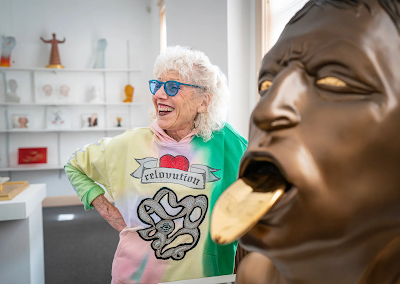


The artist Judy Chicago with her piece “Grand Bronze Head with Golden Tongue” in her gallery and studio in Belen, N.M.


Chicago with her piece “Grand Bronze Head with Golden Tongue” in her gallery and studio in Belen, N.M.

Credit: Gabriela Campos for The New York Times


Full article here.


Wednesday, September 20, 2023

IN CONVERSATION ONLINE – Frank Vaccaro on Tony Vaccaro

Frank Lloyd Wright Foundation graphic - white text on orange background


 Via Frank Lloyd Wright Foundation

 Taliesin West

October 5, 2023


Explore the Life and Lens of Legendary Photographer Tony Vaccaro!


Michael A. “Tony” Vaccaro (1922 – 2022), was an American photographer perhaps best known for his World War II photos. After the war, he became a fashion and lifestyle photographer for American magazines, capturing the joys and beauties of the world we live in. He lived to be 100 years old.

Join us on October 5, 2023, for an exclusive online conversation with Tony Vaccaro’s son, Frank. He will share invaluable insights into his father’s remarkable legacy and unveil his father’s captivating story. We’ll delve deep into Tony’s early career, the different chapters of his life, and get unique insights into his time with O’Keeffe and Wright ahead of the debut of American Icons: Wright & O’Keeffe at Taliesin West opening on October 20.

Details:

Links for virtual programs will be sent via email in advance.
If you have any questions about Cultural Programs at Taliesin West, please refer to our FAQ.  

Time:
10:00 a.m. – 11:00 a.m.
Online

Price:
Adults $25
Students (13-25 with student ID) $17
Members $22.50

Frank Lloyd Wright Foundation Members receive discounts on Cultural Programs, have access to special Member-Only programs, and more. Learn about Membership here.

BUY TICKETS


Frank Vaccaro is the eldest child of photographer Michael A. “Tony” Vaccaro and Marimekko model Anja Kyllikki Lehto. He was born in Rome, Italy, in 1965 while his father was on assignment. Frank came of age surrounded by the stories and images that make up the Tony Vaccaro collection of photographs. After graduating Stony Brook University in 1988, Frank managed bars and restaurants in New York City before joining Pepsi Cola in 1994. For the last eighteen years, Frank has been the elected representative for over 150 unionized workers there.

At his father’s request, Frank and his wife Maria created and launched the Tony Vaccaro Studio in 2015. The studio organizes over 800,000 images, and partners with the Monroe Gallery of Photography in Santa Fe, New Mexico. Upon Tony Vaccaro’s passing last year, Frank and his wife created the Tony Vaccaro Archive in Long Island City, Queens.


Friday, December 4, 2020

How Tony Vaccaro Used Photography as the Antidote to Inhumanity


How Tony Vaccaro Used Photography as the Antidote to Inhumanity

Via BLIND

Dec. 1, 2020

by Miss Rosen


As his centennial approaches, Tony Vaccaro looks back at a singular life in photography that enabled him to survive both the Battle of Normandy and COVID-19, and work for Flair, Look, and Life during the golden age of picture magazines.

After a lifetime behind the camera, Tony Vaccaro is still going strong. After recovering from COVID-19 earlier this year, the Italian-American photographer, who turns 98 on December 20, has resumed his workout routine. On an unseasonably warm late November morning, he ran a 12:54 mile; not bad for the high school athlete who shaved 42 seconds off the record in 1943. “I plan at 100 to establish a new record for running a mile,” Vaccaro says from his home in Long Island City, Queens.

Photo of Woman and Flowers like a Degas painting
After Degas, Woman and Flowers, New York City, 1960 © Tony Vaccaro / Courtesy Monroe Gallery of Photography

It’s more than a notion; Vaccaro is a survivor par excellence. Born Michelantonio Celestino Onofrio Vaccaro in Greensburg Pennsylvania, in 1922, Vaccaro was just four years old when both his parents died while the family was relocating to Italy. The horrors of his childhood linger to this day, as the photographer recounts the abuse he suffered at the hands of his father’s brother while growing up in Italy.

“My uncle and his wife never had children and they didn’t know how handle them,” Vaccaro says. “Because of this, I was punished every day. I was black and blue for 15 years of my life, until I got in the Army. They looked and asked, ‘What happened to you, son?’ I couldn’t tell the truth, that people were beating me for everything I did wrong.”
photo of Dominique Sanda in red flowers,, Cannes, France, 1975
Dominique Sanda, Cannes, France, 1975 © Tony Vaccaro / Courtesy Monroe Gallery of Photography

Though the bruises have healed, the memories remain tempered by a love his discovered as a teen. After World War II broke out in Europe, Vaccaro fled to the United States, and enrolled in Isaac E. Young High School in New Rochelle, New York. The young artist dreamed of being a sculptor but fate had other plans.

“Mr. Louis, a teacher, told me, ‘Tony, these sculptures are pretty good but you are born to be a photographer.’ I had never heard the word photography before,” Vaccaro says. “He told me, ‘You will make a great life with it,’ and by God he was right. I was then 14, 15. I’ve been a photographer for 85 years and I still feel very good.”

Portrait of the Artist as a Young Man

photo of Givenchy with camera by the pool, south of France, 1961
Givenchy with camera by the pool, south of France, 1961 © Tony Vaccaro / Courtesy Monroe Gallery of Photography

The new exhibition, Tony Vaccaro at 98, looks back at the photographer’s extraordinary career, which began in earnest when he was drafted into World War II. Deployed to Europe as a private in the 83rd Infantry Division, which was nicknamed “Thunderbolt,” Vaccaro fought in Normandy, Belgium, Luxembourg, and Germany. As a scout, he was able to make photographs bearing witness to the horrors of war from the frontline. His images of death, destruction, and defeat stand as poignant reminders of the inhumanity of war, and the necessity for survival against the odds.

“I was wounded twice but I’m still here,” Vaccaro says. “I took pictures every day of GIs fighting, dying, being wounded, so I have a collection of pictures that I took then that I don’t think another photographer ever dared to live the kind of life I did.” 

photo of  American soldier  kissing a little girl during spontaneous celebrations in the main square of the town of Saint Briac, France, August 14th, 1944
Kiss of liberation: Sergeant Gene Constanzo knees to kiss a little girl during spontaneous celebrations in the main square of the town of Saint Briac, France, August 14th, 1944 © Tony Vaccaro / Courtesy Monroe Gallery of Photography

After being discharged in September 1945, Vaccaro remained in Germany, where he worked as a photojournalist Weekend, the Sunday supplement to U.S. Army newspaper Stars and Stripes for the next four years. He returned stateside in 1949, working for Flair, Look, and Life during the golden age of picture magazines.

Soon Vaccaro was traveling the globe, making stops everywhere from the source of the Nile River to the South Pole. He remembers an assignment for Venture magazine, where he traveled north along the Nile for over 40 days in 1963. The journey ended in Alexandria and a visit with Egyptian President Gamal Abdel Nasser. Standing along the waterfront, Nasser pointed to the Roman ruins that remained, and made a reference to Caesar, telling Vaccaro, "Look, your people were here 2,000 years ago!"

Finding Love Amid the Stars

photo of  Pablo Picasso, Mougins, France, 1967
Pablo Picasso, Mougins, France, 1967 © Tony Vaccaro / Courtesy Monroe Gallery of Photography

Over the next 25 years, Vaccaro would amass one of the greatest archives of fashion and celebrity photography, creating iconic images of artists such as Pablo Picasso, Georgia O’Keeffe, Alexander Calder, Jackson Pollock, W. Eugene Smith, and Marcel Duchamp, as well as Hollywood royalty including Marlene Dietrich, Lauren Bacall, Sophia Loren, Grace Kelly, and Ali McGraw.
photo of Georgia O'Keeffe with "Pelvis" series painting, New Mexico, 196
Georgia O'Keeffe with "Pelvis" series painting, New Mexico, 1960 © Tony Vaccaro / Courtesy Monroe Gallery of Photography

“I always worked with people who were easy to be with,” Vaccaro says, recounting moments spent with everyone from fashion designer Hubert de Givenchy to filmmaker Federico Fellini. Vaccaro recounts his encounter with famous collector Peggy Guggenheim in Venice with aplomb. “If you go to her palazzo, you will see a statue of a man on a horse, and the sculptor gave the horse a penis as big from the tip of my fingers to my elbow. The day I went to photograph her, school children were coming to to visit her place, so she climbed on a ladder, and unscrewed the penis and hid it under her dress,” he says with a laugh. 

photo of Peggy Guggenheim in a gondola,  Venice, Italy, 1968
Peggy Guggenheim, Venice, Italy, 1968 © Tony Vaccaro / Courtesy Monroe Gallery of Photography

But perhaps the most special encounter he had was on assignment to photograph Marimekko, a Finnish home design and fashion company, where he met Anja Kyllikki, a model who would become his wife in 1963.“I went to a fashion show and they were 20 beautiful girls in the theater,” Vaccaro recalls. “One of them, our eyes met, and met, and met. I told her, ‘Look I feel as if I could marry you.’ And she said, ‘You took the words out of my mouth because I want to marry you.’ And that’s how I married my wife.”

Celebrating a Life in Photography

photo of Gwen Verdon in hammock in New York City, 1951
Gwen Verdon for LOOK, New York, City, 1953 © Tony Vaccaro / Courtesy Monroe Gallery of Photography

A true fighter, Vaccaro is one of the few people to survive both the Battle of Normandy and COVID-19. He attributes his longevity to the winning combination of “blind luck, red wine, and determination.” For Vaccaro, art has been the antidote for the inhumanity he has witnessed throughout his life. His spirit is filled with light and joy, and a faith in the future that includes us all.

“Mankind is an amazing animal,” Vaccaro says. “We have created so much: television, photography, monuments, great roads. The earth is paradise as far as I am concerned. We live in paradise, no question. My desire is for mankind to destroy the nations and just create one nation in the universe, one world.”

Leslie Uggams, posing in Natural History Museum, NY1963
Leslie Uggams, 1963 © Tony Vaccaro / Courtesy Monroe Gallery of Photography


By Miss Rosen

Miss Rosen is a New York-based writer focusing on art, photography, and culture. Her work has been published in books, magazines, and websites including Time, Vogue, Artsy, Aperture, Dazed, and Vice, among others.

Tony Vaccaro at 98
On view through January 17, 2021
Monroe Gallery, 112 Don Gaspar, Santa Fe, NM 87501, USA

https://www.monroegallery.com/

Saturday, September 26, 2020

Bones to pick: Obscure items in the Georgia O'Keeffe Museum


Via Pasatiempo

The Santa Fe New Mexican

September 25, 2020

Georgia O'Keeffe painting Pelvis Red with Yellow
Georgia O'Keeffe: Pelvis Series, Red with Yellow, 1945
©Georgia O'Keeffe Museum

...“I think, in particular, of the way she uses the pelvis bone,” (Museum Fellow Victoria) Plotek says. “It becomes a device she uses to frame her compositions. One of the centerpieces of her New Mexico paintings is a pelvis painting where the pelvis is sort of framing this oval of blue sky. It would be impossible for anyone to know what the motif was without looking at the label. But it becomes a recurring motif for her.”

Take, for example, Pelvis Series, Red with Yellow (1945). It looks like an abstraction: a yellow ovoid form surrounded by a nebulous, organic shape rendered in shades of pale white and ochre. Once it registers that the pale-and-ochre shape is a pelvic bone, you no longer view the painting as an abstraction but as a painting of a representational form.

“That painting, where O’Keeffe abstracts the bone, is the subject of a very famous photograph by Tony Vaccaro,”  ...

Tony Caccaro Photograph of Georgia O'Keeffe holding Pelvis Red-Yellow painting
©Tony Vaccaro: Georgia O'Keeffe with painting, New Mexico, 1960


Full article here.

Monday, May 2, 2011

EXHIBITION PREVIEW: COMPOSING THE ARTIST


Richard Avedon, New York, NY 1994
John Loengard: Richard Avedon, New York, NY 1994


THE Magazine
Santa Fe's monthly Magazine of and for the Arts
May, 2011

Composing The Artist
May 6 through June 26
Monroe Gallery of Photography
112 Don Gaspar Avenue, Santa Fe, 505.992.0800
Reception: Friday, May 6, 5 - 7 PM

There are rarely sufficient words to describe an artist's personality and work. Often it takes a fellow creator to capture the essential nature of the artist. Richard Avedon's severe, black and white images dramatically expose the nature of his subjects. His portraits of Marilyn Monroe, Twiggy, and mental hospital patients are defining images in the annals of American photography. John Loengard's photo essays for LIFE magazine, which include series on Georgia O'Keeffe and the Shakers, earned him the title of one of America Photo's "one hundred most influential people in photography". in 2005. In 1994, Loengard captured Avedon seated before the clutter of his studio. Loengard's photograph of Avedon, straddling a chair and twiddling his glasses, captures the quiteness of a photographer known for his intense and energized images. On may 6, the Monroe Gallery of Photography will open an exhibition entitled Composing The Artist, where viewers can see Loengarg's image of Avedon in addition to many more photographs of renowned creators. Over 50 images will be shown, capturing iconic artists and writers at work or in portraiture. The short list includes Salvador Dali, Georgia O'Keeffe, William Faulkner, Allen Ginsberg, Andy Warhol, and Vladmir Nobokov. In these photographs, the essential personality of the artist is revealed, and an image of the past becomes visual history.