Wednesday, August 10, 2011

Ernst Haas: Color Corrections


Color Correction by Ernst Haas, published by Steidl / www.steidlville.com
California, USA, 1976

Out There
| By Kenneth Dickerman
Via Time LightBox

Born in 1921, Vienna’s Ernst Haas is considered by many to be one of the first true masters of color photography, Though he began his career working with black and white. Following the tradition established by Henri Cartier-Bresson, who focused heavily on the decisive moment and rich monochromatic tonality, Haas would receive worldwide recognition for his early work documenting the homecoming of Austrian prisoners of War. Haas eventually moved to color, favoring its ability to work in a more metaphoric, poetic vein that photographers like Saul Leiter and Eliot Porter were examining.

A significant amount of Haas’s output throughout his career landed in the pages of mainstream magazines such as Life, Look and Esquire. But in addition to this more commercial work, Haas was always making photographs for himself. It is these photographs that the German publisher Steidl has brought together for the new book, Ernst Haas: Color Corrections. The book shows mostly unseen work by Haas, work that is at once rich in color and texture as well as being more edgy and experimental than much of the work he became known for during his lifetime.

Haas’s Color Corrections will be released by Steidl in the United States this month.

 
California, USA, 1977


New Orleans, USA, 1960


New Mexico, USA, 1975


USA, circa 1970


USA, 1967


Brooklyn, New York, USA, 1952


New York, USA, 1974


Color Correction by Ernst Haas, published by Steidl / www.steidlville.com


Tuesday, August 9, 2011

LONDON RIOTS: PHOTOS, FACIAL IMAGING, SOCIAL MEDIA POSE NEW ETHICAL QUESTIONS

Photos of alleged looters were posted to Flickr as part of Operation Withern.

The New York Times reported:

As rioting continues to roil the streets of London, local police forces are turning to the Web to help unmask those involved in the torching and looting.

On Tuesday, the Metropolitan Police of London posted a set of photos on Flickr showing people they believed to be participants in the riots. Right now the images are primarily from the Croydon and West Norwood neighborhoods in south London, although the site says that more will be posted soon.
Click for full article here.

From The Guardian: London riots: police to track rioters who used BlackBerrys

and:

Facebook and Twitter mobilises hundreds of people to clear debris from streets in London's worst-hit communities

From MSNBC: Citizen cameras capture more London looters than cops

"Yet another indicator of the pervasiveness of social media services, the erosion of anonymity online and perhaps a broader, sweeping change in people’s views about what is public and what is private."

JOE McNALLY: TEN YEARS ON EXHIBIT OPENS AUGUST 24


Via Joe McNally's Blog
In Friends, News at 6:11am

Bill Butler was with Josephine Harris and five other members of Ladder 6, inside the North Tower of WTC when it came down. They resolutely stuck with Josephine, refusing to leave her, despite her painfully slow rate of descent. Bill half carried her, cajoling her all the way about seeing her grandchildren again. The building came down, and the miracle of Josephine’s pace put all of them in a fourth floor stairwell that remained intact. Somehow, as the building came down, crushing everything around it, they, and Josephine, survived.


Bill Butler, 2001, Firefighter, Ladder 6, FDNY

While trapped with Harris and his ladder company in Stairwell B, Butler used a cell phone to call emergency numbers but couldn’t get through. As a last effort, he called his home in Orange County, N.Y. His wife, Diane, answered.


“I just said, “Hi, what are you doing?” I was trying to be nonchalant. She said, “Where are you?” I said “We’re at the World Trade Center.” She asked, “Is everything okay?” Then I said, “Well, we have a little problem. We’re trapped in the Trade Center, but we’re okay.” Then she started to cry a little bit, because she knew there was no World Trade Center. At that point I said, “Listen, you can’t cry. I have to give you some information. You have to call the firehouse or call someone and tell them where we’re at.”


Lieutenant Bill Butler, FDNY, Aug. 3, 2011


Ten years later, Bill is a lieutentant with FDNY, serving at Ladder 56, Engine 48, up in the Bronx. His memories of the day are still vivid, even with the passing of time. Shot this, along with a video interview with Bill, just last week. The interview, and the portraits open at the Time Warner Center at Columbus Circle, on Aug. 24th.
Exhibition made possible with the generous sponsorship of Nikon USA, Johnson & Johnson, JP Morgan, and friends of the collection.

More tk….


Monday, August 8, 2011

Vanity Fair: The Elvis Kiss Mystery—Solved!

 
Photograph © Alfred Wertheimer, all rights reserved


WEB EXCLUSIVE August 8, 20
Culture

The Elvis Kiss Mystery—Solved!

In the summer of 1956, a 21-year-old Elvis Presley, already inciting libidinous mayhem from Kansas City to Jacksonville, impishly touched tongues with a young woman in Richmond, Virginia. Photographer Alfred Wertheimer snapped the shutter just at the moment of contact. The result: “The Kiss,” one of the most storied photos in Elvis lore and “the sexiest picture ever taken in the whole world,” according to Diane Keaton, who owns a print. Yet for five decades, no one, not even Wertheimer, knew the identity of Presley’s date—until now.

Read the full article on VF.com here.

Sunday, August 7, 2011

EXCERPTS FROM AN EVENING OF PHOTOJOURNALISM


We were honored to welcome two  preeminent names in American journalism, former Time, Life, and People magazine editors Richard Stolley and Hal Wingo for an evening of conversation in the gallery in conjuction with the exhibition "History's Big Picture". The gallery was filled to standing room only as they talked about the power of magazine photography and photojournalism's past, present, and future.

A few excerpts from the evening:

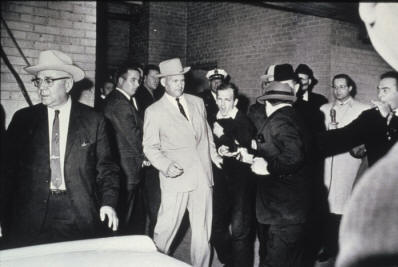
Dick Stolley recounted the events surrounding President John F. Kennedy's assassination, and how he arrived in Dallas on the evening of the assassination and met early the next morning with Abraham Zapruder and secured the original and first-generation print of the "Zapruder film" for LIFE magazine. Stolley continued that he went to the County jail for the transfer of Lee Harvey Oswald, only to learn from a TV camerman that Jack Ruby had shot Oswald as he was leaving the City jail. Stolley then singled out Bob Jackson's Pulitzer-Prize winning photograph in the exhibition and continued:

"Two pictures were taken - a guy named Jack Beers shot a split-second earlier than Bob Jackson and the difference between the two photographs is profound. This captures everything and that split second before just missed. That split second is what makes the difference in so many of the photographs on these walls."


Both Stolley and Wingo covered stories in South during the most violent years of the Civil Rights struggle. Wingo told how he found assignments in the South scared him far more than any in Vietnam. They talked about the power oF the image, and the influence civil rights photographs had on American public opinion at the time.

Dick Stolley: "When LIFE showed up there were already a lot of writers covering the civil rights stories. It was one thing to write about segregationist crowds trying to prevent nine teenagers from going into Central High School, but when you showed these photographs of angry, contorted faces it made all the difference in two ways: one, in us understanding of what was going on in Little Rock and throughout the South, and two, the attitude the people in the photographs had.

It was one thing to be written about, it was a very different thing to wind up in the pages of LIFE magazine with your face contorted in rage...and they caught on to that instantly.

America saw these photograph and thought "Good God, what is happening?"

Hal Wingo continued: "I wonder if anyone here tonight might recognize this picture? Does it ring a bell in any of you?"

He held up this photograph, a double page spread from an old LIFE magazine:


These are the 18 men arrested, including County Deputy Cecil Price and his boss, Sheriff Lawrence Rainey, for the murders of three civil rights workers James Chaney, Andrew Goodman, and Michael Schwerner. These 18 men were arraigned not on on State charges, because Mississippi did not charge them, but on Federal charges of violating the rights of the three civil rights workers. This is the picture taken just after their arraignment...do they look worried?

They thought their ace in the hole was they would be judged locally, by a jury of their peers, and that's the safest thing that could happen"

On the state of photojournalism:

Photojournalism today maybe has a broader definition than just the creative work of talented photojournalists who can arrange or capture a moment that will be a lasting impression from these situations. It seems to me today photojournalism is any photograph that is in the sense journalism, that tells the story."  Dick Stolley

We would like to graciously thank Dick and Hal for a wonderful evening of discussion.


Saturday, August 6, 2011

LUCILLE BALL AT 100


Lucille Ball as 6 different characters
Irving Haberman: Lucille Ball as six differnt characters, Promo for CBS' "I Love Lucy"


August 6, 2011

Via Entertainment Weekly:

Lucille Ball would’ve turned 100 today, almost sixty years after I Love Lucy started cracking up TV viewers and never stopped. There isn’t much new to be said about Ball’s legacy: How she defined the modern sitcom, how she paved the way for every female comedy legend — from Mary Tyler Moore to Roseanne to Tina Fey — who came after her, how her show’s popularity has outlasted all its 1950s rivals (Gunsmoke, The Honeymooners) and is still a daytime TV staple around the world.

Instead, let’s let Lucy do the talking:  click here for film clips via Entertainment Weekly


Sid Avery: Lucille Ball on the set of "I Love Lucy", 1953


Loomis Dean - Comedienne Lucille Ball Clowns During TV Episode of "I Love Lucy"
Loomis Dean: Dressed for an episode of I Love Lucy, Lucille Ball is spraying seltzer and about to place the pie in an unsuspecting face, 1952


Friday, August 5, 2011

Exhibit to showcase photojournalists' historic works; Discussion about the past, present and future of photojournalism

 Mary Vecchio grieving over stain student, Kent State, May 4, 1970

Robert Nott | The Santa Fe New Mexican
Friday, August 05, 2011

Photojournalists are the invisible documentarians of history; men and women who understand that their images will outlive them. We may all remember the classic black-and-white photo of a sailor kissing a woman in Times Square on VJ Day, 1945, but do we recall who shot it? (Alfred Eisenstaedt). Likewise, the image of Jack Ruby shooting presidential assassin Lee Harvey Oswald may remain indelibly imprinted in our minds, but do we know the name of the photographer? (Robert Jackson).

Monroe Gallery of Photography pays homage to the historical contributions made by photojournalists with both a photo exhibition called History's Big Picture and a public discussion with magazine editors Richard Stolley and Hal Wingo.

Both men worked as editors for Time, Life and People magazines, and the two will talk about the past, present and future of photojournalism at 5 p.m. Friday at Monroe Gallery on Don Gaspar Street.

"These are real moments captured by real people," Wingo said during a joint interview with Stolley at the gallery. "These were all done before the advent of Photoshop [computer software that allows manipulation of images]. These days you can't necessarily trust a picture."

Following up on that point, Stolley pointed to John Filo's photo of Mary Vecchio grieving over a slain student in the wake of the Kent State shootings in 1970 — an image hanging in the Monroe Gallery exhibition — and noted that a fence post seems to be protruding from Vecchio's head.

"Photoshop could erase that and probably make that a better picture, aesthetically, but it's not the truth," he said.

A lot of the images in the Monroe show suggest that photojournalism displays its power via tragic, sometimes bloody images — Eddie Adams's photo of South Vietnamese National Police Chief Nguyen Ngoc Loan shooting a suspected Viet Cong in the head at close range, for instance, or Bill Eppridge's image of an Ambassador Hotel busboy attempting to help slain presidential candidate Robert Kennedy.

But, as Stolley points out, "There are moments of love that are caught as well," as with Ed Clark's moving photo of an accordion player weeping as President Franklin D. Roosevelt's funeral train passes by in Warm Springs, Ga.

Though these photojournalists were well trained and prepared to capture unexpected moments, luck and timing sometimes played a hand. Stolley tells the story of two photographers who were in the same place at the same time on the morning of Nov. 23, 1963.

That's when Dallas police were transferring President John F. Kennedy's assassin, Lee Harvey Oswald, through the police headquarters basement on his way to jail. Nightclub owner Jack Ruby stepped out from the crowd and shot Ruby at close range just as photographer Robert Jackson took a photo. Jackson won a Pulitzer Prize for his efforts, but photographer Jack Beers caught nearly the same image on his camera — about half a second earlier.

"Two pictures were taken by two photographers that morning," Stolley said. "The first one (Beers) is just off; taken less than a second before the other. Jackson's is the photo that became famous."

Stolley and Wingo remember a number of photojournalists who gave their lives on the job: Robert Capa, who stepped on a land mine while covering the First Indochina War; Paul Schutzer, who was killed covering the Six-Day War in the Middle East, and Life photographer Larry Burrows, who died in a helicopter crash in Laos in 1971.

"He used up two 'nine lives' before he died," Wingo said of his colleague Burrows.

Both men feel that photojournalism remains a vibrant art form. "Young people would rather look at a picture than read," Stolley said, pointing to the success of life.com, which offers more than 10 million photos on its site.

And photojournalism does not have to rely on the written word to tell its story.

"You didn't have to say or write anything," Wingo said. "The photo says everything you want to know. The fact that it captures a moment that is frozen in time stays with you."

If you go:

What: Time, Life and People editors Richard Stolley and Hal Wingo discuss History's Big Picture

When: 5-7 p.m. Friday

Where: Monroe Gallery of Photography, 112 Don Gaspar Ave., 992-0800.

Admission: Free

Seating is first-come, first-served. The photo exhibit runs through September 25.

Related: 'This is one of the most powerful photographic shows I have ever seen and, certainly, in my opinion, the best Santa Fe has ever had the privilege of hosting.'
Review: Iconic Consciousness