Friday, June 7, 2024

History through the lens of legendary photojournalist Bill Eppridge

Via Connecticut Public Radio

By Ray Hardman

June 6, 2024

black and white photograph of Streisand in the dressing room of the Johnny Carson Show (The Tonight Show) January 1963. Photographer Bill Eppridge is standing behind her making a photograph of her reflected in the mirror. Life reporter Chris Welles is on the left behind Streisand.
Barbra Streisand in the dressing room of the Johnny Carson Show (The Tonight Show) January 1963. Photographer Bill Eppridge is standing behind her making a photograph of her reflected in the mirror. Life reporter Chris Welles is on the left behind Streisand.

Listen here

Bill Eppridge and his Nikon camera chronicled some of the most important events of the second half of the 20th century, including his iconic photograph of a dying Robert F. Kennedy shortly after he was shot in 1968.

Eppridge, who lived in Connecticut, died in 2013 at the age of 75. Since then, his widow, Adrienne Aurichio, has been cataloging his enormous body of work — photographs, negatives and other correspondence dating from his earliest days as a photojournalist.

“There is so much history in there that he didn't want any of that to be lost,” Aurichio said. “There's every note card, every postcard someone sent him, memos from editors all about his work, he saved everything because he said, ‘This is part of my legacy, part of my archive that people will want to look at later.'"

Eppridge was born in Buenos Aires, Argentina, and lived in New Milford, Connecticut. But he grew up in Richmond, Virginia during segregation.

Aurichio reflected on those formative years.

“Something that stuck with him his whole life was seeing a white policeman get on a bus and make an elderly Black woman move because she was sitting in the front,” Aurichio said. “And he was with his good friend, they were maybe 10. And he said he never forgot that, you know, just the injustice of it.”

Aurichio said that sense of empathy and injustice is evident in all of his work, but especially when he was covering the Civil Rights Movement for Life Magazine in the 1960s.

She showed a picture she recently discovered in Eppridge’s archives, just one example of the historically significant photographs she continues to uncover. The black and white image is a closeup of a Black woman addressing a crowd. Aurichio is convinced the woman is civil rights activist Fannie Lou Hamer, addressing the Mississippi Freedom Democratic Party Convention in 1964, which she co-founded.

color photograph of Connecticut Public Host Ray Hardman interviewing Adrienne Aurichio in the Bill Eppridge archices at their home in Connenticut
Julianne Varacchi
Connecticut Public Host Ray Hardman interviews Adrienne Aurichio in Danbury, Conn. for “Where ART Thou?” as they look at Bill Eppridge's photograph of civil rights activist Fannie Lou Hamer from 1964. Aurichio is the widow and publishing collaborator of famed photojournalist Bill Eppridge. Adrienne and Bill moved to New Milford in 2004, where Adrienne still lives.

“I did some research and found her in some news photos,” Aurichio said. "She was wearing the same dress and she's at the convention and she's singing. And it was only a couple of days after Bill had photographed the funeral of James Chaney.”

James Chaney was one of three civil rights workers killed by the Ku Klux Klan in Philadelphia, Mississippi, in 1964. Aurichio said some 60 years later, it’s still hard to believe that Eppridge, a young white photographer on assignment, actually went to the Chaney house and asked if he could stay with them in the midst of their grief and take pictures. They welcomed him in, and Eppridge captured a series of haunting pictures of James Chaney’s funeral for Life Magazine.

This “Fly on the Wall” approach worked well on another important assignment from earlier that year. In February 1964, Eppridge headed to JFK Airport to photograph a music group from Liverpool, England, called The Beatles, who were making their first trip to the U.S.

Aurichio said the assignment, which was only supposed to last a day, ended up lasting six days. Eppridge captured not only the youthful exuberance of the "Fab Four" on their first visit to the states, but also the fever pitch reactions of the hordes of fans fully in the throes of “Beatlemania.”


black and white photograph of The Beatles with Ed Sullivan and photographers behind them on , February 8, 1964. New York City.
Bill Eppridge/©Estate Of Bill Eppridge

The Beatles with Ed Sullivan, February 8, 1964. New York City.

Eppridge continued to cover important assignments — Vietnam, revolutions in Central and South America, and Woodstock — but his defining moment as a photojournalist came while covering the presidential campaign of Robert F. Kennedy in 1968.

“When he first heard the gunshots, he knew instantly it was a gun, and he immediately pushed forward to try and see what had happened,” Aurichio said.

Kennedy was assassinated after addressing a crowd of supporters gathered at the Ambassador Hotel in Los Angeles. Aurichio said Eppridge was one of the first to enter the hotel kitchen where Bobby Kennedy lay dying.

“It's somewhat extraordinary that he could make that picture,” Aurichio said. “So he had to have the wherewithal in a split second to say, ‘OK, I can't do much. There are other people closing in. What can I do as a photographer? This is history.’ And in his mind, he thought it really has to be documented because you don't want questions later, as there always are with JFK’s assassination.”

The photograph, that of a dying Kennedy laying in a circle of overhead light, his head cradled by a kitchen worker, is one of the most iconic photographs of the 20th century.

Aurichio said Eppridge never stopped taking photographs.

Even during his long bout with pancreatic cancer, Eppridge continued to be a “fly on the wall,” capturing the beauty and spontaneity of his subjects, just as he had done for decades.


Bill Eppridge's photographs are featured in the current "1964" exhibition though June 23, 2024. More of Eppridge's work may be found here.

Wednesday, June 5, 2024

D-Day + 80: remembering Tony Vaccaro


black and white photograph showing waterfront and beach at Normandy, 1944
Tony Vaccaro: Normandy, June, 1944


As a U.S. Army private, Tony Vaccaro's boat sailed for Normandy on D-Day+12 in June 1944, before landing, June 18. 

Just before leaving for France, while all the other soldiers were busy checking their gear, Tony secretly wrapped his Argus C3 camera in layers of plastic to keep it from the water and to hide it from his commanding officer. He photographed the Normandy coast through a buttonhole in his outer jacket.

Drafted into the war at the age of 21, he was denied access to the Signal Corps, but Tony was determined to photograph the war and had his portable 35mm Argus C-3 with him from the start. For the next 272 days, Tony fought on the front lines of the war, documenting his personal witness to the horrors of war.

The pictures – many of them raw, graphic, disturbing – follow his advance, and that of his unit, the 83rd Infantry Division, from the beaches to Berlin.

They represent one of the most complete collections of images of World War II, as seen through the eyes of someone who fought during the conflict. 

Read "D-Day through a lens: ‘First the rifle, then photographs’" on CNN

In 1994, the 50th anniversary of the D-Day landings, Tony was awarded the French Legion of Honor, among many other awards and recognitions. The documentary film Underfire: The Untold Story of Pfc. Tony Vaccaro Underfire: The Untold Story of Pfc. Tony Vaccaro premiered at the Boston Film Festival in 2016 and was distributed by HBO.  The film led to a career renaissance for Tony Vaccaro.

color photograph of Tony Vaccaro, left, with John Kerry at a ceremony marking the 70th anniversary of D Day, June 7, 2014 - By U.S. Department of State
Tony Vaccaro, left, at a ceremony marking the 70th anniversary of D Day, June 7, 2014
Via US Department of State/Wikipedia

Tony Vaccaro passed away peacefully on December 28, 2022, eight days after celebrating his 100th birthday.


A new exhibition, "TONY VACCARO: The Pursuit of Beauty" opens at Monroe Gallery of Photography on July 5, 2024, and will be on view through September 15, 2024.


Tuesday, June 4, 2024

The man in front of the tank: How journalists smuggled out the iconic Tiananmen Square photo

 Tiananmen Square: How journalists smuggled out the iconic ‘Tank Man’ photo | CNN

Via CNN

June 4, 2024


"The journey of the photograph, too, captured the tension and fear of the time – involving smuggling equipment and film past authorities and across borders. By that point, the Chinese government was trying desperately to control the message going out to the world – and was trying to stop all American news outlets, including CNN, from broadcasting live from Beijing.

It was Monday, June 5, 1989, and Beijing was reeling from the crackdown the day before. Liu Heung-shing, the photo editor for the AP in Beijing, asked Jeff Widener to help get photos of Chinese troops from the Beijing Hotel – which had the best vantage point of the square, now under military control.

Widener had flown in from the news agency’s Bangkok office a week before to help with coverage, and was hurt when the crackdown began, he told CNN previously – after having been hit in the head by a rock, and laid low with the flu.

He set off, with his camera equipment hidden in his jacket – a long 400-millimeter lens in one pocket, a doubler in another, film in his underwear and the camera body in his back pocket.

“I’m biking towards the Beijing Hotel and there’s just debris and charred buses on the ground,” he said. “All of a sudden, there’s four tanks coming, manned by soldiers with heavy machine guns. I’m on my bicycle thinking I can’t believe I’m doing this.”

“I hear rumors that other journalists had had their film and cameras confiscated. I had to figure out a way to get into the hotel,” he added. “I look inside the darkened lobby, and there’s this Western college kid. I walked up to him and whispered, ‘I’m from Associated Press, can you let me up to your room?’ He picked up on it right away and said, ‘Sure.’”

From there, Widener began photographing the tanks rolling by on the roads below – sometimes hearing the ring of a bell that signified a cart passing by with a body, or an injured person being taken to the hospital, he said.

Widener was at the window, preparing to photograph the column of tanks coming down the road, when “this guy with shopping bags walks out in front and starts waving the bags,” he said. “I’m just waiting for him to get shot, holding the focus on him, waiting and waiting.”

The tank stopped and tried to go around the man. The man moved with the tank, blocking its path once again. At one point during the standoff, the man climbed aboard the lead tank and appeared to speak to whoever was inside.

But Widener had a problem – the scene was too far away for his 400-mm lens. His doubler, which would allow him to zoom in twice as much, lay on the bed, leaving him a choice: Should he go grab the doubler, and risk losing the shot in those precious seconds?

He took the chance, got the doubler on the camera, took “one, two, three shots. Then it was over,” he said. “Some people came, grabbed this guy, and ran off. I remember sitting down on this little sofa next to the window and the student (Martsen) said, ‘Did you get it? Did you get it?’ Something in the back of my mind said maybe I got it, but I’m not sure.”

Liu remembers getting the call from Widener, and immediately firing off instructions: roll up the film, go down to the lobby, and ask one of the many foreign students there to bring it to the AP office.

The pictures were soon transmitted over telephone lines to the rest of the world.

Widener did, sending the student bicycling away with the film hidden in his underwear. Forty-five minutes later, “an American guy with a ponytail and a backpack showed up with an AP envelope,” said Liu. They quickly developed the film, “and I looked at that frame – and that’s the frame. It went out.”


“I suppose for a lot of people it’s something personal, because this guy represents everything in our lives that we’re battling, because we’re all battling something,” Widener said. “He’s really become a symbol for a lot of people.”

Monday, June 3, 2024

Foot-dragging in Marion raid investigation should fill public with dread

 Via The Kansas Reflector

June 3, 3024


"I’ve had it.

Nearly 10 months after law enforcement officials raided the Marion County Record and two private residences, officials have yet to tell us the results of their investigations. That’s nearly a full year since a flagrant assault on free speech in Kansas, one signed off on by a list of city, county and state officials. True, a handful of individuals implicated in the scandal have left their roles in the intervening time. Lawsuits have been filed.

But we have not heard from those in charge. The Kansas Bureau of Investigation, perhaps realizing it had been compromised by involvement in the raid, passed the entire affair over to the Colorado Bureau of Investigation. They originally said results would come in April. We’re at the beginning of June, and those results still haven’t come.

Our First Amendment rights, those shared by both journalists and the entire American public, deserve better."


And background here, and here.

Saturday, June 1, 2024

Arrests of journalists already doubled over last year

 Via US Press Freedom Tracker Via US Press Freedom Tracker

May 31, 2024


graph chart showing number of journalists arrested 2017 through 2024


"Friends of the U.S. Press Freedom Tracker:

Welcome back to your newsletter around press freedom violations in the United States. Find archived editions here, and get this newsletter directly in your inbox by signing up here.One month later — arrests have doubled

In my last newsletter, I wrote about journalists covering local reaction to the Israel-Gaza war, noting that as April came to an end, we had documented 13 arrests or detainments of members of the press, and were actively reporting on more. Active, indeed: As of today, we’ve documented 36.

Importantly, the number of journalists arrested or detained so far this year — which is not even half over — is more than the last two years combined.

In addition to arrests, we’ve captured more than 30 assaults of journalists under our “Israel-Gaza war” tag since Oct. 7, 2023 — seven of those on student journalists — and nine reports of damaged equipment."

Thursday, May 30, 2024

Mark Peterson Photographs For The New York Times Magazine


black and white photograph of Pro-Palestinian protest at Columbia University seen through silhouettes of 2 policemen

A pro-Palestinian protest on Columbia University’s campus this spring

Credit: Mark Mark Peterson


May 29, 2024

"When private universities set rules for what speech they allow, including when, where and how students can protest, they can impose more restrictions than the First Amendment allows in public spaces. But for decades, they have claimed free speech as a central value, and that promise has a particular history at Columbia. In 1968, the administration called in the police to evict student demonstrators from Hamilton Hall, which they had occupied in protest of the university’s involvement in military research and a new neighborhood-dividing gymnasium project in Morningside Park. For more than half a century now, campus activism and universities’ responses to it have mostly occurred within the paradigm shaped by 1968. But the upheavals on campuses across the country this spring were different. The campus war over the real war in Gaza did something no issue since Vietnam had done. It seemed to have prompted an abrupt rethinking of free-speech principles that many in academia assumed to be foundational.

For the first time since the Vietnam War, university demonstrations have led to a rethinking of who sets the terms for language in academia." ---full article


Tuesday, May 28, 2024

Female Directors In Plain Sight Features Amalie R. Rothschild; Gallery Talk June 8

 Via Guild Cinema Via Guild Cinema


FEMALE DIRECTORS IN PLAIN SIGHT shorts series - PAINTING THE TOWN: THE ILLUSIONISTIC MURALS OF RICHARD HAAS, IT HAPPENS TO US and POSSUM LIVING

Jun 4 thru 6

Tue to Thu 3:30, 8pm


DIRECTOR AMALIE ROTHSCHILD WILL BE IN PERSON FOR THE SCREENINGS PLUS CINEMATOGRAPHER NANCY SCHREIBER WILL BE PRESENT FOR ALL SHOWS EXCEPT THE FINAL THURSDAY 8PM SCREENING!

GALLERY TALK: The Fillmore East and My Unexpected Career in Rock Music PhotographyGALLERY TALK: The Fillmore East and My Unexpected Career in Rock Music Photography

Monroe Gallery of Photography, June 8, 4:30 PM


PAINTING THE TOWN: THE ILLUSIONISTIC MURALS OF RICHARD HAAS - Director Rothschild, along with cinematographer Nancy Schreiber, fashions her own exuberant film mural based on the life and very public work of the celebrated architectural muralist Richard Haas. Since 1974 his “trompe l'oeil” paintings have caused double takes from Munich to Phoenix. His artistry transforms cityscapes in ways that confound and delight. He is an artist with a mission–to make the urban environment visually pleasurable, and therefore more livable and humane.  [Dir. Amalie R. Rothschild - 1990 - 56m approx.]

IT HAPPENS TO US - Made in 1971 by an all-woman crew, women who are rich and poor, young and older, black and white, married and unmarried, tell dramatic stories about why and how they ended their pregnancies when abortion was still illegal.  [Dir. Amalie R. Rothschild - 1972 - 30m approx.]

POSSUM LIVING - Hailed by the New York Times when it premiered at MoMA’s New Directors series, director Schreiber went on to become one of America’s few successful women DPs – most recently with the hit TV series P-Valley– but she was never given another chance to direct a movie.  This short documentary tells the story of Dolly Freed, author of the 1970s cult classic Possum Living.  It shows how this father and daughter pair quit their job and school respectively to live out of their suburban home. As per the book's subtitle, it teaches how to "live well without a job and with (almost) no money."

ABOUT THE DIRECTORS - NANCY SCHREIBER, ASC and AMALIE R. ROTHSCHILD

Nancy Schreiber (ASC) is an award-winning director and  cinematographer based in both New York and Los Angeles. Schreiber has  directed four  dance films including RITES of PASSING and documentaries which included the award winning POSSUM LIVING and an hour long PBS film on women artists called FROM THE HEART.She was the fourth woman ever voted into membership into the prestigious American Society of Cinematographers. Schreiber has compiled over 130 credits, an eclectic list of narrative film and television credits as well as music videos, commercials and documentaries. Schreiber landed on Variety’s 10 cinematographers to watch before taking home the coveted Best Cinematography award at Sundance for the film NOVEMBER, with Courteney Cox. Schreiber has been nominated for an Emmy, an Independent Spirit Award nominations, was awarded the Women In Film Crystal /Kodak award, and in February 2017 was the first women honored with the ASC ( American Society of Cinematographers) President’s award . Schreiber is also a member of the the TV academy , Film Independent, International Documentary Association, Local 600. Women in Film,  and Academy of Motion Picture Arts and Sciences. 

Amalie R. Rothschild is one of the four founders of the successful and progressive 53-year-old distribution cooperative New Day Films. An award-winning filmmaker and photographer she is noted for her documentaries about social issues as revealed through the lives of people in the arts. Ms. Rothschild's keen eye has documented seminal events in history. She was the de facto photographer at the Fillmore East Theater in NYC and on staff at the 1969 Woodstock Festival and the author of Live at the Fillmore East: A Photographic Memoir. Her films include the groundbreaking It Happens to Us made in 1971 with an all-woman crew and the first American film to argue that women should have the right to control their own bodies and end a pregnancy. Other films are Nana Mom and Me, Conversations with Willard van Dyke, and Woo Who? May Wilson. Her film  Painting the Town: The Illusionistic Murals of Richard Haas premiered at Sundance, was shown in the New Directors/New Films sponsored by the Museum of Modern Art and the Film Society of Lincoln Center and won the Best in Festival Emily Award at the American Film and Video Festival, as well as a Golden Gate Award at the San Francisco International Film Festival, among other honors. While based professionally in New York City, since 1983 she lives roughly half the year in Italy.


Wednesday, May 22, 2024

War Photography: Movie vs Reality

Via The Real Frame: War Photography on Screen - The Real Frame


May 21, 2024 by David Butow David Butow


As if the political tension in the United States couldn’t get any higher, this spring a new movie depicting a full-scale, near-future civil war in the country is filling theaters and drawing good reviews. The film, “Civil War”, directed by Englishman Alex Garland, (“The Beach”, “Ex Machina”), imagines that the country is ruled by a quasi-dictator serving his third term as president. The opposing side is comprised of a well-organized and equipped army of rebels (called the “Western Alliance”), that is on the move to Washington, D.C. to remove him from power.

The main point of the movie is, I think, to force audiences to confront the possibility, however remote, that something like this could actually happen. The U.S., despite illusions of “exceptionalism,” is fundamentally no different from any other empire that can break down and/or break apart. This is big stuff, but the POV of this terrible scenario is told through the narrow experiences of a group of four journalists, principally two still photographers played by Kirsten Dunst and Cailee Spaeny.

It’s rare that photojournalists are the main protagonists in a film, they’re usually quirky side characters like Dennis Hopper’s idiosyncratic portrayal of a half-crazed Vietnam War photographer in “Apocalypse Now.” But putting them in the center of the plot requires detail of their working habits, and more importantly, into the emotional and ethical challenges they face as they make their way through one violent situation after another. The whole raison d’être of them being there is questioned. Are they after the thrill or some greater good? What is the role of journalistic observers in conflict? I can’t say those questions are deeply examined but they are certainly put up on the metaphorical blackboard (or video projector if you prefer).

If you haven’t seen the film but might go, be aware there is a lot of violence depicted, sometimes rather realistically and without the heavy music and other mood overlays we’re used to in Hollywood movies. I found this starkness jarring, but effective. Another thing I thought the film did rather well was show how quickly things can happen, often when you’re not expecting them, and also how chaos and semi-normalcy can exist in proximities much closer than you might expect.

Conversely, I thought there were some things about the journalists the filmmakers definitely got wrong, but how many movies have I seen where the main characters are lawyers, doctors, cops or soldiers? I imagine that people in those professions, who are used to being depicted on screen, don’t usually overanalyze every misleading detail. But the photojournalistic community, never shy about taking itself seriously, and with a rare spotlight on its profession, has had a lot to say about “Civil War.”

The best commentary I’ve seen is in the video here. It features a thoughtful interview with photojournalists Lynsey Addario, Peter van Agmatel, Ron Haviv and John Moore. These four have about as much experience covering conflicts as any photographers working today, and they are all highly intelligent and deeply reflective about those experiences. In addition, the photographer Mohamed El Masri, speaking with the assistance of a translator, describes the specific danger and challenges with covering the war in Gaza.

They’ll tell you what they thought of the movie, but more important, how they think about the role of the press, and what it is really like to witness, record and communicate terrible acts of violence.


Tuesday, May 21, 2024

"The fact journalists were arrested for documenting events should concern all who believe in the free flow of information. "

 Via The Santa Fe New Mexican "Our View"

May 21, 2024

Journalists must be able to do their jobs

Journalists have no right to break the law in covering stories of public interest — that goes without saying even though the Constitution’s First Amendment clearly protects freedom of press. That freedom includes gathering the news, not just its publication.

Because of that protection, news reporters and photographers must be left alone to do their jobs. That’s especially true in a breaking-news situation in which impartial witness is essential. That’s one — but only one — reason police officers’ decision to arrest a reporter and photographer on the University of New Mexico campus while they documented the clearing of an encampment of student protesters is so distressing.

Independent journalist Bryant Furlow and photographer Tara Armijo-Prewitt — a married couple — were at the campus Wednesday morning to observe what likely would be the last days of the encampments. Furlow said he accompanied Armijo-Prewitt, who had been documenting the weeks-long protests, early Wednesday because UNM President Garnett Stokes had said the day before that police would be tearing the camps down.

Like reporters everywhere, Furlow wanted to be on the ground as news was happening. As with any potential clash between police and protestors, the public interest is clear. Journalists must be allowed to do their work. That did not happen last week.

According to a statement released through New Mexico In Depth — an online organization to which Furlow often contributes — the reporter gave his account of events, citing his request for information from officers on where to stand and his willingness to follow police instructions. He said he also informed officers he was a member of the media.

Nevertheless, both Furlow and Armijo-Prewitt were arrested.

The fact journalists were arrested for documenting events should concern all who believe in the free flow of information. Both state police and UNM campus police were involved in removing the encampments. Their bosses — Gov. Michelle Lujan Grisham and Stokes — should be investigating to find out why journalists doing their jobs and complying with officers were arrested.

The arrest after a reporter asked for a badge number and while photographing police actions is particularly troubling. It shows an apparent unwillingness on the part of police to have their actions documented for the public to see.

As Foundation for Open Government Executive Director Melanie Majors said, “If the media is arrested for doing their job, where does that leave the rest of us?”

The two, according to Furlow’s statement, were charged with criminal trespass and wrongful use of public property. They spent about 12 hours in custody after their arrests. Campus police made the arrests, and the correct action now is to drop the charges and apologize.

Further, given the tenor of the times — these protests are not going away — police at every level must be better educated about the rights of the media. Officers must understand they have no right to stop journalists from doing their jobs. In fact, when they do so, those officers are violating the Constitution.

There can be no freedom of the press without freedom to gather the news. Period.


 Statement from New Mexico reporter about his arrest at UNM encampment protest 

“Upon arriving on the scene, I asked officers where news media were permitted to stand to document the operation and did not receive an answer. I asked officers several times if there was a public information officer on scene with whom I could speak and was told there was not. I also inquired about who was in charge but got no response. We at all times followed instructions we received from police and stayed behind the yellow police tape. We were arrested while photographing the operation and shortly after asking an NMSP officer for his badge number and name. As I was being arrested, I said I was a member of the press repeatedly and loudly. 

“We spent approximately 12 hours in custody following our arrests. 

“We want to secure legal representation to fight the criminal charges before we speak further about our arrests.

“Thank you.” 

Monday, May 20, 2024

Save the date June 8 for a Gallery Talk With Amalie R. Rothschild


Amalie R. Rothschild
Janis and Tina, Madison Square Garden, November 27, 1969

Gallery Talk With Amalie R. Rothschild

Award-winning photographer, filmmaker and author of “Live At The Fillmore East”


Santa Fe--Monroe Gallery of Photography, 112 Don Gaspar, is pleased to announce a gallery talk, free and open to the public, with acclaimed photographer and filmmaker Amalie R. Rothschild on Saturday, June 8. RSVP is essentialRSVP is essential, seating is limited and the talk will begin promptly at 4:30. A special selection of Rothschild’s rock photographs will be on exhibit alongside the current “1964” exhibit. current “1964” exhibit.

An award winning filmmaker and photographer, Rothschild studied with Harry Callahan at RISD and Paul Caponigro at NYU where she made her first film; it was shown at the 1970 New York Film Festival.

She is noted for her documentaries about social issues as revealed through the lives of people in the arts, and for her photographs of seminal rock events, venues and musicians from 1968 to 1974. She was a member of the Joshua Light Show at the Fillmore East Theater in New York producing special effects photography, slides, graphics, films and film loops used during performances and was considered the theater’s unofficial house photographer. She had unlimited access onstage and backstage to all the happenings at the Fillmore East, and was on staff at the 1969 Woodstock Festival.

During that period she photographed most of the major rock music events on the East Coast including the 1969 Newport Festival, Tanglewood 1969 & 1970, The Who’s U.S. premiere of their rock opera Tommy and the Rolling Stones at Madison Square Garden, Bob Dylan’s 1974 tour, and in England the 1969 Isle of Wight Festival, as well as anti-war/peace demonstrations in the U.S. during the 1960s. Her monograph “Live at the Fillmore East: A Photographic Memoir,” was published in 1999.

In this talk she will discuss how being in the right place at the right time, and the accident of her documentary impulses, led her to record the birth of rock theater and how this created a 20,000 picture archive which has sustained her professionally into her 70s.

Gallery hours are 10 to 5 Daily. Admission is free. For further information, please call: 505.992.0800; E-mail: info@monroegallery.com. Both exhibitions continue through June 23, 2024.


Friday, May 17, 2024

Out There: When I’m (19)64

 Via Pasatiempo

May 17, 2024

black and white photograph of African American man on pay telephone with "Freedom Now" on the back of his t-shirt, 1964


Not to make anyone feel elderly, but the 1960s are now more than 60 years old.

That startling fact leaps to the fore when one considers Monroe Gallery of Photography’s newest exhibit, simply titled 1964. The gallery calls it the year the 1960s truly began, complete with inflection points such as the musical British Invasion, Muhammad Ali becoming the world heavyweight boxing champion, and the slayings of three civil rights workers in Mississippi.

Several images show fans in states of euphoria over seeing — or preparing to see — The Beatles. In Bill Eppridge’s The Beatles With Ed Sullivan, about a dozen men hold cameras to document the band’s every move. It’s not unlike fans in 2024 using cellphones for the same purpose. In Bob Gomel’s Black Muslim leader Malcolm X Photographing Cassius Clay, Ali hams it up, while the usually stoic civil rights figure grins behind the camera. In Eppridge’s Kent Courtney, National Chair of the Conservative Society of America, Courtney tightens his tie, cutting a powerful image of buttoned-up status quo conformity.

The gallery will host a talk with Amalie R. Rothschild, a filmmaker and photographer who has created documentaries about social issues, at 4:30 p.m. June 8. — B.S.


details

Through June 23

Monroe Gallery of Photography

112 Don Gaspar Avenue

505-992-0800; monroegallery.com

Tuesday, May 14, 2024

E-Photo Newsletter: New York Photography Show, Presented by AIPAD, Returned to Form at the Park Ave. Armory

 Via The E-Photo Newsletter

May 14, 2024

By Michael Diemar

"The 43rd edition of The Photography Show felt very much a homecoming for exhibitors and visitors alike. Following stints at Pier 94 and Center415, the fair returned to what many regards as its rightful home, the Park Avenue Armory. The venue itself looked better than ever and the overall quality of the works on show was excellent. But there was also something else that came into play. While most of the people I talked to described the fair as beautiful, they also pointed out that it was manageable. There were 77 exhibitors in all, plus a separate section for publishers and rare book dealers. Some art fairs have twice that number of exhibitors, if not more, and it gets exhausting, plus, quality tends to suffer."  Click for full article.


"Next, I spoke to Sidney S. Monroe, of Monroe Gallery, Santa Fe. The gallery showed a powerful presentation of photojournalism, including works by Mark Peterson, Ryan Vizzions and Sanjay Suchak.

Monroe explained. "Photojournalism has been our focus for over 30 years, photographers who document our history and our times. We have a wide roster of photojournalists, some go back to the mid-20th century and right up to events that are happening today. For this edition of the fair, we brought a little bit more of the contemporary work than we have in the past. It's important work and artistic work but I think with all the challenges the world faces, it's more important than ever."

I was particularly struck by Sanjay Suchak's images of a statue of Robert E. Lee in Charlottesville being melted down and repurposed. Monroe told me, "The monument was a flashpoint for the protests following the death of George Floyd, as were the other Confederate monuments in the South. Sanjay photographed the protests at the statues, the removal of them, and we are including two images of the melting down of the Charlottesville statue, the end of the circle for that community, and we have had great success with them here. Our booth has been very well received. We have always had great success with museums at this fair. It's extremely satisfying to see museums taking the leap towards contemporary, more immediate work. When all is said and done, I think it will have been a very successful fair for us."

Saturday, May 11, 2024

Big Idea: The Power of Imagery and the Civil Rights Experience


Via Humanities Kansas Big Idea series.

May 7, 2024


Note: Due to copyright restrictions, the images are accessible by clicking on the corresponding links.

Margaret Bourke-White, World’s Highest Standard of Living (1937)

Great photographs open your eyes to the world around you, raise awareness, and make you feel emotion. They are powerful reminders of our history and allow us to bear witness to our collective past. Perhaps some of the most powerful early images are of activist, orator, and formerly enslaved man Frederick Douglass. (More by Margaret Bourke-White)

Various Artists, Photos of Frederick Douglass.

Douglass escaped slavery in 1838, the same year that Louis Daguerre took the first photograph of a person in Paris. Douglass recognized that photography could be a powerful tool, and he constantly sat for the camera to communicate to the world a serious, intelligent, engaged, good-looking, and dignified man. This made him the most photographed American in the 19th century. Douglass said, “When you look at a photograph of me you will never deny that I am a man worthy of freedom and citizenship. You will look me in the eye and see my humanity.”

Just as Douglass recognized the power of photography as a tool to help put an end to slavery and injustice, photographers during the Civil Rights era turned their cameras toward the fight for equality and human rights. Their business was to tell the truth about the lives of African Americans.

Dr. Ernest C. Withers, Sanitation Workers assemble in front of Clayborn Temple for a solidarity march, Memphis, TN (1968)

These photographers were brave, steadfast, and determined to shed light on our behavior as a nation. They used the power of the still image to expose the atrocities that were occurring in this country on a daily basis.

Their work was tireless and dangerous, done out of duty and honor. The price of liberty is eternal vigilance, and part of that vigilance comes from a visual way of understanding what we are experiencing and what needs to be confronted.

One of the most famous photographers of this era was a Kansan: Gordon Parks was born in Fort Scott in 1912, the youngest of 15 children in a family deeply affected by the racial terror used to enforce Jim Crow segregation. As his memoir of the same title explains, he saw the camera as his “choice of weapons” against all the things he disliked about living in America as a Black man.

Gordon Parks, Doll Test, Harlem, New York, 1947

Parks became the first Black photographer for Life Magazine, giving a voice to the marginalized, downtrodden, and underrepresented. In 1947 he photographed the Doll Test for Ebony magazine. This famous psychological test by Drs. Kenneth and Mamie Clark presented young children with a white doll and a Black doll. They were asked to identify which doll they preferred, which one was good, and which one was bad. Most children chose the white doll. When asked which doll was most like them, some children became upset when they had to identify with the Black doll. The study revealed the psychological damage of segregation and influenced the Supreme Court’s monumental Brown v. Board of Education decision that separate was not equal.

Will Counts, Elizabeth Eckford and Hazel Bryan (or “The Scream Image”), 1957

Will Counts was born and raised in Little Rock, Arkansas, and took one of the most iconic images of the Civil Rights movement: Elizabeth Eckford trying to enter high school surrounded by a white mob; Hazel Bryan is yelling at her from behind, her face contorted with anger. This image has become a notorious symbol of white hatred and followed both Eckford and Bryan throughout their lives. In 1963 Bryan apologized to Eckford for her behavior. Counts photographed them again in 1997; they struck up an unlikely friendship and spoke at schools about tolerance, but the friendship eventually ended.

Charles Moore, Alabama Fire Department Aims High-Pressure Water Hoses at Civil Rights Demonstrators, Birmingham Protests, May 3, 1963

Photographer Charles Moore was born in Hackleburg, Alabama, in 1931. He credited his parents for giving him strength, faith, and acceptance of all people. He said, “Pictures can absolutely make a difference and have an impact on society, that’s what photojournalism is. They allow white people to see the violence and cruelty that Black Americans must endure.” The protests in Birmingham were a turning point for Civil Rights as Moore captured the violence and brutality that peaceful protesters endured. Moore said that “they seemed to enjoy beating on these people, and had such hatred in their faces as they committed these atrocities and spewed their anger and venom.”

McPherson & Oliver, Escaped slave Gordon, also known as "Whipped Peter," showing his scarred back at a medical examination, Baton Rouge, Louisiana (1863)

Spider Martin, Alabama God-Damn (1965)

In 1965, James “Spider” Martin captured this image from the Selma Voting Rights March. It’s a powerful message and one that calls back to the infamous photograph of the formerly enslaved man named Peter, taken 102 years earlier. Peter (also known as Gordon) endured a harrowing 10-day journey while barefoot and chased by bloodhounds. He found safety among Union soldiers encamped at Baton Rogue; when he was examined by military doctors, they discovered the horrific scars on his back from beatings. The image, which came to be known as “Whipped Peter,” is one of the strongest testaments of the brutality of slavery and helped to fuel the abolitionist movement. Fast forward to 1965; this unidentified man is fed up and defiant. Rev. Martin Luther King once said to Spider Martin, “Spider, we could have marched and protested forever, but if it weren’t for guys like you it would have been for nothing. The whole world saw your pictures, and that’s why the Voting Rights Act passed.”

Bob Gomel, Black Muslim Leader Malcolm X photographing then Cassius Clay, Miami, 1964

Bob Gomel was a photographer for Life Magazine and was known for his iconic images of world leaders and popular culture. He took this image of Malcolm X photographing Cassius Clay in Miami. Gomel said, “The atmosphere was celebratory and jubilant, and it was very easy to be around these men and capture their true essence.” Both men would make sure to carefully craft their public images, assuring they were taken seriously and knowing that controlling the narrative was a source of power for Black people. The site—a diner lunch counter, itself a symbol of resistance—was certainly no accident. Clay would change his name later that same year, abandoning his “slave name” and adopting Muhammad Ali, which filled him with pride and power. Tragically, Malcolm X would be assassinated early the following year.  (See more at the exhibition 1964)


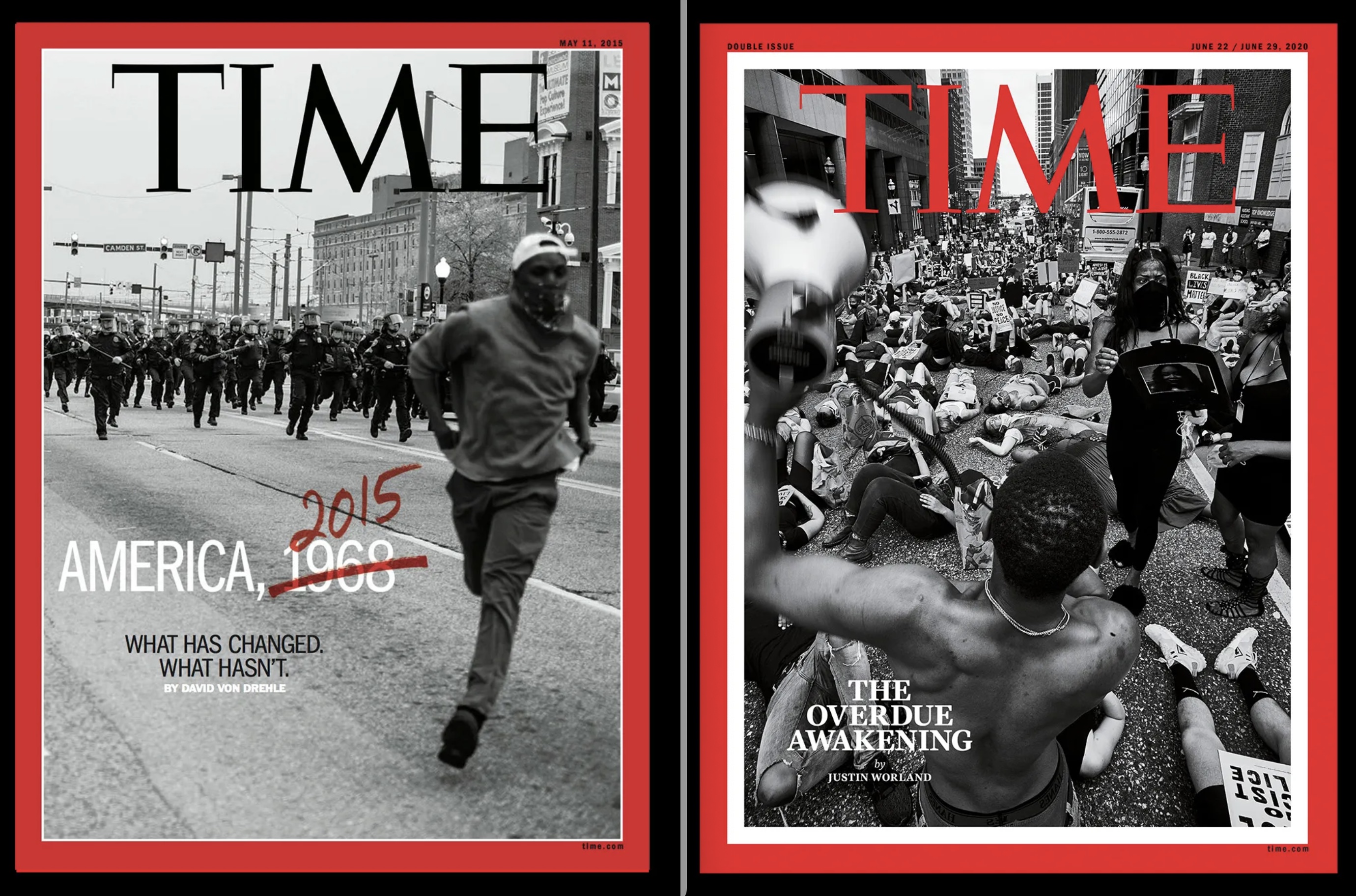
 .Devin Allen, Time Magazine covers, 2015 and 2020

Devin Allen, Time Magazine covers, 2015 and 2020


Today, a new generation of Civil Rights photographers stand on the shoulders of trailblazers like Douglass and Parks: Devin Allen, LaToya Ruby Frazier, Sheila Pree Wright, Patience Salanga, and Daewoud Bey among many others continue the work of showing us the struggle for equality. We need these important images and voices to make sure the stories are told and not brushed under the rug. Through photos, we feel these incidents and can see a mirror of ourselves. They show us that this is our burden as Americans: that united we stand, but divided we fall.


Ann Dean is an artist and freelance photographer who teaches photography at the Lawrence Arts Center.

Monday, May 6, 2024

Lynsey Addario at the 2024 Santa Fe International Literary Festival

Via The Santa Fe International Literary Festival


 On the Big Stage with Lynsey Addario

May 18, 2024, 11:00 AM - 12:15 PM

Tickets here

LYNSEY ADDARIO is the author of the New York Times bestselling memoir It’s What I Do and a celebrated photojournalist covering conflicts in Ukraine, Afghanistan, Iraq, Libya, Lebanon, Darfur, South Sudan, Somalia, Yemen, Syria, and the Democratic Republic of Congo. She regularly photographs for The New York Times, National Geographic, and Time and has been named by American Photo Magazine one of the five most influential photographers of the past 25 years. Addario was the official photographer for the Nobel Peace Center’s 10th Peace Prize Exhibition and has been the recipient of numerous awards, including a MacArthur “genius” fellowship and the Overseas Press Club’s Olivier Rebbot Award for best photographic reporting from abroad in magazines and books. She was also part of the New York Times team to win the 2009 Pulitzer Prize for International Reporting. In 2018 Penguin Press published her first solo collection of photography, Of Love and War. She lives in London.

Featured Book: It's What I Do: A Photographer's Life of Love and War by Lynsey Addario

Saturday, May 4, 2024

The Massacre at Kent State University


black and white photograph showing Mary Vecchio grieving over slain student, Kent State, May 4, 1970
Mary Vecchio grieving over slain student, Kent State, May 4, 1970

Via Field of View: Rarely-seen alternate angles of one of the most iconic photos in history.

"Bullets were whizzing over John Filo’s head during his lunch break from the student photo lab at Kent State University on May 4, 1970. He dropped his camera and stood motionless as National Guard troops suddenly opened fire on students protesting the Vietnam War.

Thirteen seconds and sixty-seven shots later, four students were dead and nine wounded.

“Was I shot?” Filo wondered."  Full article here.


Via ABC News/AP: AP Was There: Ohio National Guard killed protesters at Kent State University


Via KSU News: Remembering the May 4 shootings at Kent State University 54 years later


Via Inside Higher Ed

Thursday, May 2, 2024

Search Continues for Bill Eppridge's Skateboarder


Via SKATEboarding

May 1, 2024


Tony Hawk and Dan Rodo Are One Step Closer to Finding 'Central Park Mystery Skater' From 1965

The search for the dapper skater from LIFE magazine (1965) continues.

Brian Blakely
May 1, 2024


For as long as I can remember, Tony Hawk has periodically hopped on Instagram in hopes of identifying what he calls "the icon of style" in a photo shot by photographer Bill Eppridge in 1965 for LIFE magazine. Maybe you've seen it?

Well, on April 19th, artist (and downright impressive investigative journalist, whether he considers himself one or not), Dan James Rodo joined forces with the Birdman to see if the social media world could help them uncover the story of the mystery man in this iconic photo. They just dropped the fourth installment... and they're getting extremely close! This is getting good. Check it out:


If you're just hearing about this, you should definitely stop what you're doing and follow Tony and Dan on Instagram (@tonyhawk / @danocracy) because they've really been digging deep to uncover this mystery, but like thousands and thousands of others, I've become personally invested. Again—Tony has been posting about this mystery skater forever and I'm pretty thrilled that they're not giving up.

They've been in touch with everyone from ex-LIFE magazine editors to Surfer magazine editors; the New York Parks Department to folks who were in Central Park during the shoot that day... as well as the gallery that represents photographer Bill Eppridge's work, his wife and so much more. This is the real deal!

There has been no shortage of comments on the posts either, offering potential leads, support and generally keeping the conversation going. It's so rad. Dan mentions that he plans on having another update posted within a week (honestly, these videos can't be that easy to make... so we salute you, Dan!) and we're all patiently waiting to see if he struck gold or uncovered anymore gems.

We'll be posting any updates here as they're available. In the meantime... keep it up, dudes! We're all rooting for you. Let's find this mystery man!

Gallery Photographer Nina Berman Photographs "Columbia's Campus in Crisis" for The New Yorker

 Via The New Yorker

May 2, 2024

screenshot from The New Yorker article of the face of a young pro-Palestine female protestor


Every day since the start of the encampment, Nina has come to campus with her camera, positioned herself inconspicuously in the crowd, and captured slices of this fraught and fractured moment in our history.


See more from Nina Bermans here.

Tuesday, April 30, 2024

A few highlights from the 2024 AIPAD Photography Show


White Hot Magazine: The Photography Show (AIPAD) 2024 returned this year to their previous home, the grand Park Avenue Armory.

"The Photography Show truly stepped up their game this year, bringing a new breath of Spring air by including new galleries. They have created a great visual atmosphere of the classics and newest trends of the photography world of today."

screenshot of a photograph of Ryan Vizzion's Flooded Church print

Ryan Vizzions
A church flooded by Hurricane Florence


Collector Daily: Highlights from the 2024 AIPAD Photography Show, Part 1 of 2

"..a wandering sweep through the booths in search of eye-catching works worth thinking about more."


screenshot of photograph of Sanjay Suchak's print of foundry worker's preparing to melt down the face from the Robert E. Lee statue

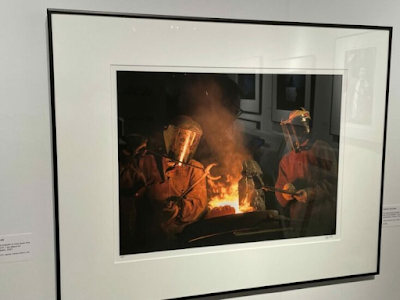
Monroe Gallery of Photography (here): In the past few years, as various Confederate monuments and statues have been removed or dismantled, we’ve seen plenty of photographs of graffitied pedestals and boxed up bronzes waiting for transport. This image by Sanjay Suchak powerfully continues the story, with the face of Robert E. Lee about to be melted down by metal recyclers. 


Tuesday, April 23, 2024

Bob Gomel Day Proclaimed


screenshot of Huston Mayor's proclamation for "Bob Gomel Day"

Bob Gomel Day

WHEREAS, Houstonian Bob Gomel has dedicated eight decades to the advancement of American photojournalism and imagery of world cultures; and

WHEREAS, Bob Gomel’s love of photography began in his youth in New York City, continued with his graduation from New York University with a journalism degree, through his service abroad as a U.S. Navy Aviator, and into his emergence as a professional photographer; and

WHEREAS, Bob Gomel captured the triumphs and tragedies of the 1960s as a photographer for LIFE magazine, making iconic and innovative images of world leaders and events, athletes and entertainers, and great moments in contemporary history; and

WHEREAS, Bob Gomel’s notable LIFE assignments included photographing President John F. Kennedy’s historic “We Choose to Go tothe Moon” speech at Rice University on September 12, 1962; and

WHEREAS, Bob Gomel moved to Houston in the 1970s and opened a photography studio where he produced images of leading political, business, academic and medical figures, and he helped co-found the Houston chapter of the American Society of Media Photographers; and

WHEREAS, Bob Gomel’s famous 1997 photograph, “Fireworks Over Houston,” is in the permanent collection of The Museum of Fine Arts, Houston; and

WHEREAS, Bob Gomel is the subject of the documentary Bob Gomel: Eyewitness directed by David Scarbrough, and Gomel’s work remains of interest to historians, news organizations and collectors around the nation; and

WHEREAS, Bob Gomel’s contemporary photography emphasizes world cultures and life abroad and includes images from Asia, Europe and The Americas; and

WHEREAS, Bob Gomel’s photographic archives have been donated to the Briscoe Center for American History at The University of Texas at Austin, and a newly published selection of his life’s work is exhibited at the 2024 Fotofest Biennial in Houston; and
 
WHEREAS, The City of Houston commends and recognizes Bob Gomel for his contributions to photojournalism in Houston and beyond;

 THEREFORE, I, John Whitmire, Mayor of the City of Houston, do hereby proclaim April 23 2024, as  Bob Gomel Day In Houston, Texas


Bob Gomel's photographs are featured in the current exhibition 1964


Sunday, April 21, 2024

Monroe Gallery at the 43rd edition of The Photography Show,

Color graphic for the AIPAD Photography Show with dates of April 25-28, 2024 and Monroe Gallery booth location A52


Monroe Gallery of Photography is delighted to announce its participation in the highly anticipated 43rd edition of The Photography Show, the longest-running and leading fair dedicated to photography, returning this year to the iconic Park Avenue Armory in New York City from April 25 to 28, 2024.

Marking an exciting homecoming for The Photography Show, this edition promises a spectacular showcase of photography. The expansive Armory space will host 77 exhibiting galleries and a dedicated photobook sector, creating a unique and exciting experience for collectors and enthusiasts alike.

The Photography Show, located at 643 Park Ave, New York, NY 10065, will open its doors with a VIP Preview on Thursday, April 25, followed by the official opening on Friday, April 26, at 12 pm. That evening, the fair will feature a Night of Photography from 5 pm to 8 pm, providing a unique evening experience. On Saturday, April 27, and Sunday, April 28, the show will be open to the public from 12 pm to 7 pm and 12 pm to 5 pm, respectively.

Monroe Gallery of Photography will be located at Booth A52 and will exhibit a curated selection of important contemporary photojournalism, with a central focus on Sanjay Suchak's “Take Them Down” project documenting the deinstallation and repurposing of monumental Confederate statues along with photographs Mark Peterson made at the Robert E. Lee monument in Richmond, Virginia in 2020. Other issues addressed by Gallery photojournalists in our exhibit will include climate change, women’s rights, and the 2016 Standing Rock protest movement to stop the Dakota Access pipeline. The Gallery will also have a special selection of fashion, WWII, and portrait photographs by Tony Vaccaro, who passed away in December 2022 at the age of 100 and who was a frequent presence in the Monroe Gallery booth through past AIPAD Shows.

We look forward to seeing you in our booth #A52! Please email us with any questions. Preview our exhibition here.