Monroe Gallery of Photography specializes in 20th- and 21st-century photojournalism and humanist imagery—images that are embedded in our collective consciousness and which form a shared visual heritage for human society. They set social and political changes in motion, transforming the way we live and think—in a shared medium that is a singular intersectionality of art and journalism.
— Sidney and Michelle Monroe
Directed by journalist, documentary filmmaker and CNN alum Heather O’Neill, the feature doc tells the story of five courageous and trailblazing female photojournalists — Jane Evans, Maria Fleet, Margaret Moth, Mary Rogers and Cynde Strand — who documented major world events from Tiananmen Square to the Arab Spring, Sarajevo to South Africa and more. The film features all five women describing the risks they faced when reporting under fire — complemented by behind-the-scenes footage of situations in which they had to brave highly dangerous circumstances in order to get their story — as well as reflecting the challenges they faced working in a field that remains dominated by men.
The documentary had its world premiere at the 2021 Tribeca Film Festival, and later screened at Hamptons Doc Fest.
No Ordinary Life was produced by Array Films, with Rich Brooks serving as producer. The acquisition deal was negotiated for CNN Worldwide by Stacey Wolf, senior vice president of business affairs, and Kelly MacLanahan, assistant general counsel, on behalf of CNN Films.
Monroe Gallery is pleased to welcome Adrienne Aurichio to Santa Fe on September 30 for a talk about the life and career of legendary photojournalist Bill Eppridge. The talk opens a new exhibition of Eppridge's photographs that features many new, rare early works.
Most likely readers have seen some or all of the photographs hanging on the wall of the Monroe Gallery in Santa Fe, NM. Gallery co-owner, Sid Monroe will explain, though, that matting, framing, and gallery display transforms these images to something beyond their original use to document a current event. When viewed away from the newspaper or magazine page, multiple levels of meaning are conveyed through these photographs. They provide us with insight into a historical period in today’s world.
The exhibit currently displayed, Imagine A World Without Photojournalism, coincides with the 20-year celebration of Monroe Gallery’s presence in Santa Fe. Michelle and Sid Monroe opened their gallery in New York City but moved to Santa Fe in the aftermath of the terrorist events of 9/11. Their focus has always been on photojournalism. To that end, they have had the advice and support of some of the most noteworthy members of that community, the likes of Alfred Eisenstaedt and Carl Mydans. Some of the earliest advice was the suggestion that such a gallery could not succeed.
The gallery has survived. The current exhibit serves as a retrospective of the shows that have been hung in their transplant location in New Mexico. Viewers will find iconic photos such as Robert Capa’s images from Omaha Beach on D-Day, June 6, 1944, Eddie Adams’s Saigon Execution, and numerous photos originally seen in Life magazine to photos from the present day Australian photojournalist, Ashley Gilbertson’s depiction of Officer Eugene Goodman holding back January 6th insurrectionists. The broad range of material serves to communicate the importance of photojournalism in our lives and for the several generations before us. The exhibit is important at a time when journalism is under attack (along with journalists) and lacking in funding.
This exhibit runs through September 18, 2022. For those who cannot make it to Santa Fe during the run of the exhibition, Monroe Gallery has produced a video sampler of many of the images on display. The presentation Threats to Photojournalism with photographers Nina Berman and David Butow took place in the gallery on Friday, July 22 but can be accessed on YouTube. Details on the presentation and the exhibit can be found at the Monroe Gallery website.
The cops in riot gear, standing in the background brandishing batons during Jimenez’ live shot, wanted the street cleared. And this reporter from CNN was another body standing in the way.
“As a reporter, it’s the last thing you’d expect would happen in the United States,” Jimenez says, by way of recounting his arrest during a conversation with investigative journalist Ronan Farrow. “I was in this professional mode of being a reporter at first … then trying to figure out, wait, what the hell is going on right now?”
That conversation is part of new footage HBO Max is releasing today in support of “Endangered,” an HBO Original documentary film that debuted in June about journalism in its current state of global crisis.
Directed by filmmakers Heidi Ewing and Rachel Grady, with Farrow as executive producer, that documentary presents vignettes of reporters from around the world. From places as disparate as Mexico City, Miami, and Sao Paulo, where reporters like photojournalist Sáshenka Gutiérrez grapple with recalcitrant public officials, death threats, an indifferent public, an uncertain business model, and other hazards to their livelihood and lives.
“I hope that the documentary can change the mentality of some people a little — make them understand that without journalists, there is no democracy,” Gutiérrez told me. “(And) show them the different forms of violence that we face.”
In all, “The Endangered Tapes” includes six new pieces of content featuring Farrow interviewing journalists like Jason Rezaian, the Washington Post opinion writer arrested in Iran and held in the country’s notorious Evin prison for 544 days. As well as Selene San Felice, formerly of The Capital Gazette and a survivor of the newsroom shooting there.
"While we were producing ‘Endangered,’” Farrow told me, “I was guided by conversations with fellow journalists about their experiences and views on the state of the free press. I’m happy to share some of those behind-the-scenes exchanges with the world. These are bite-sized, informative glimpses into the lives of different kinds of journalists, facing different challenges. I learned a lot from them, and I’m so glad that the HBO Documentaries team — and the journalists I spoke with — are allowing others to see them too."
The documentary and supplemental content encourages viewers to not take for granted that the profession of bearing witness undertaken by reporters will always exist in its current form. That existential threats are ever-present. And that there is a man or a woman behind every byline, as well as a home and a family that the correspondent you see on TV will return to at the end of the day.
For journalists like Jimenez, there is also an everlasting tension between functioning as an objective reporter — and as someone with a life outside of that work, someone who’s not dispassionate about the people and things they encounter.
“A lot of times, being reporters, I think we fall into this pattern of — I have to be so objective that I am removed from the story,” Jimenez tells Farrow. “The story is over here, but I am back here.”
“This,” Jimenez continues, about his arrest, “was a situation where I couldn’t escape it.”
Censorship Is a Missing Picture: Photojournalist Grant Baldwin discusses what we don't see
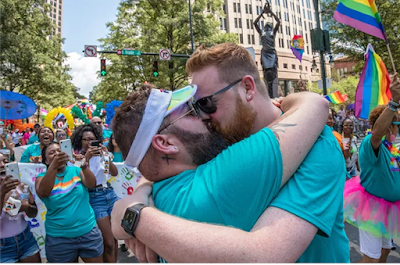
Grant Baldwin: 2019 Charlotte, North Carolina Pride Parade, August 18, 2019
What is censorship? How do we recognize when it is happening, and how do we address it? Please join local photojournalist Grant Baldwin to discuss his photographs, their impact, and his experience with censorship.
The Gaston County Manager ordered the removal of a photograph on display as part of an exhibit titled Into the Darkroom at the Gaston County Museum of Art and History. According to the Charlotte Observer, "LGBTQ equality advocates are demanding officials in Gaston County reverse their decision to remove a photo showing two men recently engaged, kissing, from a museum exhibit. The photograph, taken by Charlotte freelance photojournalist Grant Baldwin, shows Justin Colasacco and his husband Bren Hipp kissing after Colasacco dropped to one knee and proposed in front of the crowd at the 2019 Charlotte Pride Festival & Parade. They married Oct. 4, 2020." According to the Gaston Gazette, the Gaston County Manager claimed that the photograph was political advocacy and wanted Mr. Baldwin to replace it with something else. The photojournalist chose instead to leave the display spot on the wall empty to demonstrate that something was missing.
Grant Baldwin is an award-winning freelance photojournalist based in Charlotte NC who focuses on visual story telling. His work has appeared in multiple local and national news outlets. He recently won the North Carolina Press Association's 2020 Best Multimedia Project for Black Lives Matter Coverage.
Dallas Center for Photography Welcomes Back Renowned Photojournalist Ed Kashi with an Exhibition, Artist Talk & Book Signing Celebrating Work from his Newly Released Monograph
For forty years, celebrated photojournalist Ed Kashi has delivered the world's stories through images that both imply, as well as directly show, humanistic challenges and joys. Abandoned Moments: A Love Letter to Photography (Kehrer Verlag) is a window into Kashi's unique voice and craft, and presents glimpses of ordinary life, as well as extraordinary events, struggles, and triumphs – the chaos of everyday life.
The images selected for Kashi’s book and exhibition span the decades of his work and were taken around the world. Shot entirely from the hip, Kashi flips standard photography conventions by snapping these "abandoned moments" without looking through the viewfinder, seeking to capture moments shaped by serendipity and instinct, rather than objectivity and intellect. “They are free to be less controlled but for that very reason they may be more certain and more certainly true,” Kashi explains about the evolution of his style and methodology.
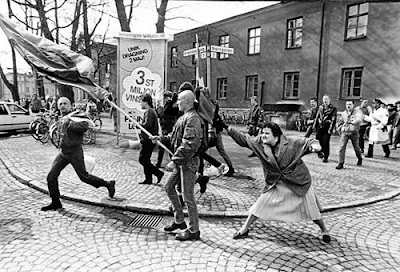
The reprint of a 1985 photo by Hans Runesson in a recent Pasatiempo of an elderly Swedish woman slugging a neo-Nazi in the back of the head with her handbag during a rally, is quite possibly the funniest thing I have ever seen. It provoked in me the most extravagant hilarity and happiness. Look at her! She puts her entire body into it. Her face is contorted in a grimace of pure rage. She looks like she is of the generation that actually experienced the real Nazis and knows what these silly, idle, testosterone-laden young boneheads do not know or will not recognize: that all of it was pure hell.
Slugging that young man must have been immensely satisfying. I will admit with only the smallest trace of shame that I wish I could have similarly slugged one of these boneheaded, malevolent and violent Jan. 6 rioters in the back of the head with my handbag. The photo is now on my fridge, to be enjoyed for weeks to come as a sort of counterweight against the hopelessness that befalls me at times these days."
On July 22, photojournalists Nina Berman and David Butow spoke about threats photojournalists are facing. Both photographers covered January 6 at the US Capitol and talked about their experiences during the insurrection riot. View the discussion here on the Monroe Gallery YouTube page.
"Throughout its history, our institution has collected and exhibited photographs and films that address timely and timeless topics. For example, we have recently acquired the powerful photograph (above) taken by Ashley Gilbertson, who bravely documented the events at the United States Capitol during the insurrection on January 6, 2021."