Via Women Photograph
December 15, 2025
Monroe Gallery of Photography specializes in 20th- and 21st-century photojournalism and humanist imagery—images that are embedded in our collective consciousness and which form a shared visual heritage for human society. They set social and political changes in motion, transforming the way we live and think—in a shared medium that is a singular intersectionality of art and journalism. — Sidney and Michelle Monroe
Via Women Photograph
December 15, 2025
Via Ballarat International Foto Biennale
September 9, 2025
Panel Discussion: The Personal and Collaborative: Women Photographers on Relationship–Focused Modes of Representation
Nina Berman and Raphaella Rosella in conversation with Fiona Morris and Gemma Turnbull
Online Event - Book here
Contemporary documentary photographers and photomedia artists seek to address issues of representation and testimony by utilising new storytelling approaches, including nonlinear narratives, repurposing archival footage and collaborative practices. There has been a move from photographers recording ‘the other’ to working with non-artist individuals to share their own lived experiences. This turn towards the personal and collaborative has been led by women, rejecting the selective history which has been represented by the dominantly white, male, heteronormative gaze of the documentary mode. The work still questions and highlights social issues, including gender, representation and displacement, but from personal perspectives.
This online panel exploring the ethics, benefits and challenges of a collaborative documentary approach will focus on two women photographers: American documentary photographer Nina Berman’s whose work An Autobiography of Miss Wish (2017) is the product of a 25–year exchange between her and friend and collaborator Kimberly Stevens and Australian artist Raphaela Rosella who has spent decades co-creating photo-based projects alongside significant women in her life––low socio-economic communities with limited access to adequate support and opportunities. It will be led by Dr Gemma Turnbull and Fiona Morris, both Australian photographers and academics.
Participants will be emailed a Zoom link prior to the panel.
Please note: parental guidance may be needed for participants under the age of 18.
About the Panel
Nina Berman is a documentary photographer, filmmaker, journalist and educator. Her work explores American politics, militarism, environmental issues and post violence trauma. She is the author of Purple Hearts – Back from Iraq, (Trolley, 2004) portraits and interviews with wounded American veterans, Homeland, (Trolley, 2008) an examination of the militarization of American life post September 11, and An autobiography of Miss Wish (Kehrer, 2017) a story told with a survivor of sexual violence which was shortlisted for both the Aperture and Arles book prizes. Her work has been exhibited at more than 100 international venues from the Whitney Museum Biennial to the concrete security walls at the Za’atari refugee camp. Public collections include the Smithsonian National Museum of American History, the Museum of Fine Arts, Houston, the Museum of the City of New York, the Harvard Art Museums and the Bibliothèque nationale de France among others. She has participated in workshops around the world for young photographers and writes frequently on photojournalism for the Columbia Journalism Review. She is a professor at Columbia University’s Graduate School of Journalism in New York City.
Fiona Morris is an Associate Lecturer in Visual Arts and Photography at the University of Wollongong where she is also a PhD candidate. Her photographic practice and research explore representation and personal narratives in the expanding field of documentary photography. With over 15 years of experience, Fiona has worked extensively across media and non-governmental organisations, including as a photographer for Fairfax Media, Getty Images, Greenpeace Australia, and Médecins Sans Frontières (MSF). Her work has been exhibited in galleries and festivals both nationally and internationally, with shows in the United States, France, Lithuania, and Hong Kong.
Raphaela (Rosie) Rosella is an Italian Australian artist from Nimbin – an over-policed, low socio-economic community in New South Wales. For over fifteen years, she has worked at the intersection of socially engaged art and documentary practice, co-creating lens-based works alongside her sisters, friends, and family – women directly impacted by the Prison Industrial Complex (PIC). Together, they have built a co-created archive spanning photography, moving image, audio, and the collection of ephemera and state-issued documents, to resist bureaucratic representations of their lived experiences. Beyond the gallery, their work plays a critical role in legal and personal spaces – appearing in family albums, memorials, custody disputes, and courtrooms. It has supported successful bail and parole applications and contributed to reduced custodial sentences. Rosella holds a PhD from RMIT’s School of Art (2025). From an abolition feminist standpoint, her research offers a relational framework for decarcerating archives within long-form and collaborative documentary photography projects.
Gemma Turnbull is an Australian artist, researcher, and educator whose work exposes and challenges the historical weaponisation of photography against marginalised communities. She positions collaborative practice as a reparative approach to documentary storytelling, focusing on amplifying images made by and with people typically excluded from mainstream art spaces.
July 27, 2025
From October 25, 2025 to February 8, 2026, the frescoed halls of the Chiostri di San Pietro in Reggio Emilia will host Margaret Bourke-White. The Work 1930-1960, a retrospective exhibition dedicated to Margaret Bourke-White (New York, 1904 - Stamford, 1971), one of the most significant figures in twentieth-century photography. The initiative is promoted by the Fondazione Palazzo Magnani in collaboration with CAMERA - Italian Center for Photography, and curated by Monica Poggi. The exhibition presents 150 images spanning three decades of the author’s activity, including industrial reportage, war scenarios, social transformations and geopolitical conflicts. Born in New York in 1904 and passed away in 1971, Bourke-White was able to build an international career distinguished by her ability to deal with extreme contexts, both in terms of logistical difficulties and political implications, establishing herself as a direct witness to the events that marked the century. The exhibition is divided into six sections, following a chronological and thematic criterion, including industrial reportage, conflict and major social transformations. Click to read full article
Related article: Margaret Bourke-White. The work 1930-1960
March 29, 2025
Lisa Larsen photographed the 1953 wedding of Senator John F. Kennedy and Jacqueline Bouvier Kennedy, and one print is featured in the current exhibition "Loving"
“Women can be good photographers much in the same way that they can become good doctors, good cooks or whatever they choose to be good at,” Lisa Larsen said in the mid-1950s. By that point she had become one of LIFE Magazine’s most successful photojournalists, having already won Magazine Photographer of the Year in 1953. In that time, she became known for her interest in the truth of humanity. “I dislike anything superficial and I especially dislike superficial relationships,” she said in 1954.
Lisa Larsen, née Rothschild, arrived in the U.S. as a Jewish emigre from her native Germany–her family left after Kristallnacht. She was just a teenager at the time, but knew the career path that was right for her. By then, a group of German Jewish photographers had elevated photojournalism as an artform in the U.S. and formed the influential photography agency Black Star, one of Magnum’s greatest competitors. Larsen joined them as a file clerk. She then began her career as a freelance photographer for magazines like The New York Times Magazine, Vogue, Seventeen, Glamour, and more, but she worked at LIFE for a decade beginning in 1949.
At first, as a woman, she was relegated to fashion and entertainment photography–she took photos of Marlon Brando and Grace Kelly, for example, though even those somehow situate megawatt stars of the time as mere mortals, a way audiences hardly got to see them then and, arguably, still now.
Over time, Larsen was able to expand her practice and become an intrepid, adventurous world traveler. She became, for example, “the first American photographer to enter Outer Mongolia after a government-enforced 10-year ban,” as LIFE wrote. She also traversed the Himalayas; photographed world leaders at the first Bandung Conference in Indonesia, which sought to solidify African-Asian relations’ and Eastern Europe during the Cold War in 1955, among many others. She was additionally sent to photograph high-ranking political figures from Dwight D. Eisenhower on his campaign for president and First Lady Bess Truman, wife of Harry S. Truman; to Nikita Khrushchev and the 1953 wedding of Senator John F. Kennedy and Jacqueline Bouvier Kennedy, not to mention Queen Elizabeth II’s first tour as a royal.
Larsen was known to be both charming and hardworking, and knew how to get a great photo. In her time, she dazzled many a world leader. “Appreciative Khrushchev gave Larsen a bouquet of peonies,” scholar Patryk Babiracki wrote in Apparatus Journal. “Ho Chi Minh spotted Larsen…and confessed: ‘If I were a young man, I'd be in love with you,’” Babiracki continued. Truman Vice President Alben Barkley called her “Mona Lisa.” According to the International Center of Photography, “she photographed Iran’s Premier Mohammed Mossadegh from his New York hospital bed during the 1951 Iranian oil dispute with Great Britain,” which “led to a personal invitation from Mossadegh to visit Iran for a two-week vacation.”
Via Mongolian National News Agency
August 22, 2024
Ulaanbaatar, August 22, 2024 /MONTSAME/. The Opening Ceremony of the “Resilience - Stories of Women Inspiring Change” Special Exhibition was held at the Lkham Gallery, Ulaanbaatar City, Mongolia, on August 21, 2024.
The World Press Photo Foundation and the Kingdom of the Netherlands present a selection of stories, awarded in the World Press Photo Contests from 2000 to 2021, that highlight the resilience and challenges of women, girls, and communities around the world.
This exhibition promotes women’s rights, gender equality, and justice. Multiple voices, documented by 17 photographers of 13 different nationalities, offer insights into issues, including sexism, gender-based violence, reproductive rights, and access to equal opportunities. The selection of stories explores how women and gender issues have evolved in the 21st century and how photojournalism has developed in the ways of portraying them. The photographs show the power of visual storytelling to create mutual understanding and to influence or change our views.
At the Opening Ceremony, Cultural and Public Diplomacy Counsellor of the Netherlands to Mongolia Ingrid de Beer noted, “We are grateful to present the Resilience Photo Exhibition in cooperation with the Dutch Foundation World Press Photo and Lkham Gallery of Mongolia. The exceptional selection of photographs illustrates women and girls from all over the world—women and girls who face difficult challenges, even violence. Yet, instead of focusing on their challenges, these images highlight their personality, strength, and resilience. The women in Ulaanbaatar that I met today demonstrated their determination and perseverance to create change. I hope you enjoy the Resilience Photo Exhibition and that it serves as an inspiration to further our collective efforts toward a gender-equal society.”
Delgermaa Byambasuren, Honorary Consul of the Netherlands in Mongolia, said, “I'm delighted to welcome the World Press Photo exhibition to Mongolia for the first time. The "Resilience" exhibition features photographs by 17 photographers from 13 countries, highlighting women's rights, gender equality, and the evolution of women's issues in the 21st century. We are deeply grateful to the Ministry of Foreign Affairs of the Netherlands and the World Press Photo Foundation for their commitment to women's rights. We also extend our thanks to Lkham Gallery and our other partners for their meticulous work in making this exhibition a reality.”
Gender equality and justice are fundamental human rights critical in supporting cohesive societies. Yet, women around the world face deeply entrenched inequality and remain underrepresented in political and economic roles. In 2021, women represented just 26.1% of some 35,500 parliament seats, only 22.6% of over 3,400 ministers, and 27% of all managerial positions. Violence against women prevails as a serious global health and protection issue. An estimated one in three women will experience physical or sexual abuse in her lifetime.
The gender imbalance is also evident in photojournalism. Data collected by Women Photograph in 2020 shows that an average of just 20% of lead photographs published by eight of the world’s most widely read newspapers were taken by women. The number of female entrants to the World Press Photo Contest has increased over the past five years from 15% to 20% in 2022. This data underlines the need for us to continue working on reducing gender injustice. We need women's perspectives to contribute to a diverse and balanced representation of the world.
The “Resilience - Stories of Women Inspiring Change” Exhibition will be open to the public until September 18, 2024, at the Lkham Gallery in Ulaanbaatar.
Traditionally, girls in the Zanzibar Archipelago are discouraged from learning how to swim, largely due to the absence of modest swimwear. In northern Zanzibar, the Panje Project teaches local women and girls swimming skills in an effort to reduce high rates of drowning. Full-length swimsuits are provided. In addition to challenging a patriarchal system, the project has created a sustainable cycle by empowering students to teach other
July 26, 2024
Monday - July 29, 2024 12:00 PM Eastern Time
Nina Berman is a documentary photographer, filmmaker, journalist, and educator. Her work explores American politics, militarism, environmental issues, and post-violence trauma.
The photographer is the author of Purple Hearts – Back from Iraq (Trolley, 2004), which features portraits and interviews with wounded American veterans. Berman is also the author of Homeland (Trolley, 2008), which is an examination of the militarization of American life post-September 11th. She is also the author of the autobiography of Miss Wish (Kehrer, 2017), a story told about the survivor of sexual violence. Miss Wish was shortlisted for the Aperture and Arles book prizes.
Additional fellowships, awards, and grants include the NY Foundation for the Arts, the World Press Photo Foundation, Pictures of the Year International, the Open Society Foundation, the Center for Documentary Studies at Duke University, the MIT Knight Science Journalism Fellowship, and The Aftermath Project.
Berman began her photography career in 1988 as an independent photographer working on assignments for the world’s major magazines including Time, Newsweek, Life, the NY Times Magazine, NY Magazine, German Geo, and The Sunday Times.
The photographer covered a range of issues, from women under siege during the war in Bosnia and Afghanistan, to domestic issues of criminal justice, reproductive rights, and political process. Berman's work has been exhibited at more than 100 international venues from the Whitney Museum Biennial to the concrete security walls at the Za'atari refugee camp.
Public collections include the Smithsonian National Museum of American History, the Museum of Fine Arts, Houston, the Museum of the City of NY, the Harvard Art Museums, and the Bibliothèque Nationale de France, among others.
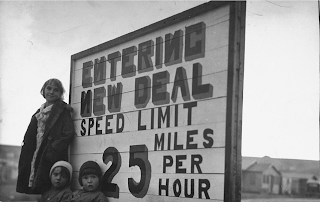
Margaret Bourke-White, photograph from “Franklin Roosevelt’s Wild West,” LIFE, November 23, 1936 © LIFE Picture Collection, Dotdash Meredith Corp. Margaret Bourke-White became one of the first four staff photographers at LIFE in 1936.
This exhibition has been generously supported by Joyce B. Cowin, with additional support from Sara Lee Schupf, Jerry Speyer, Robert A.M. Stern and Northern Trust.
Support for this exhibition at the Greenwich Historical Society has been generously provided by Josie Merck and annual donors to the Greenwich Historic Trust.
Oct. 26, 2023
BYU’s Museum of Art debuted its new exhibit “Life: Six Women Photographers” earlier this month, highlighting six influential women photographers’ work from the 1930s to the 1970s.
The exhibit features the work of photojournalists Margaret Bourke-White, Hansel Mieth, Marie Hansen, Nina Leen, Martha Holmes and Lisa Larsen.
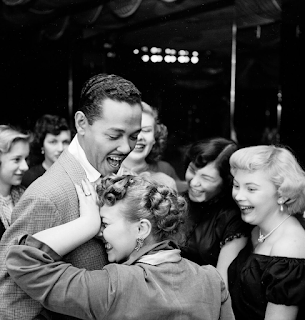
Featured within the new installation are a variety of photos, such as Marie Hansen’s photo essay showcasing the 20th century Women’s Army Auxiliary Corps, and Margaret Bourke-White’s photographs depicting the impact of the American economic depression on the people of the 1930s. Photographer Nina Leen highlights the work of women and mothers, while portraits of Hollywood personalities are featured in Martha Holmes’ photos of Billy Eckstine. Hansel Mieth’s photos focus on depicting the reality of labor forces and the experiences of the general public.
BYU students, local community members and visitors now have the opportunity to visit the Museum of Art’s new exhibit and appreciate the talent of these six female photojournalist pioneers.
“I think it’s cool that we’re honoring female photographers,” Sally Bradshaw, a BYU junior, said.
Bradshaw continued to describe the photos in the exhibit as “down to earth.”
“They capture very emotional moments, it seems. It’s pretty inspirational,” BYU student Logan Berry said.
Life Magazine, which ran weekly from 1883 to 1972 and monthly from 1978 to 2000, focused on showing “The Most Iconic Photographs of All Time,” according to Life Magazine‘s website.
The “Life: Six Women Photographers” exhibit at the BYU Museum of Art gives visitors the opportunity to witness for themselves the photographs of the six featured photographers. The exhibit displays photos both published and unpublished by Life.
“It’s like a crazy cool opportunity to be able to see these things that at one point were just in a magazine but are now really important,” BYU student Katy Turner said.
Turner continued to express interest in the past and future BYU Museum of Art photography shows because of the focus on important events.
“A lot of times we try to make it a focus and like a point to remember prominent women in history or maybe women in history who were amazing but we don’t really know about,” Bradshaw said. “I think it’s really cool that BYU wants to give a space to that because we’re all about honoring amazing people.”
“Life: Six Women Photographers” was organized by the New-York Historical Society and will be on display in the BYU Museum of Art until Feb. 3, 2024.
There will be a panel discussion discussing the exhibit and photography, art history and journalism on Thursday, Oct. 26 at the Museum of Art. BYU professors and faculty members Heather Belnap, Melissa Gibbs and Paul Adams will be presenting.
Museum of Art educator Liz Donakey will also host a gallery talk regarding the exhibit on Wednesday, Nov. 29.
Students can schedule a tour of the exhibit on the Museum of Art website.
Related exhibit: The LIFE Photographers
Sunday, April 23, 2023
Two pioneering women photographers who were blacklisted by the Red Scare share wall space at Santa Fe’s Monroe Gallery of Photography.
Both Sonia Handelman Meyer and Ida Wyman were members of the Photo League. The league was a collective of photographers active from 1936-1951, who believed their work could change poor social conditions and champion photography as an art form. It thrived as one of the most progressive, dynamic and creative centers for photography in the country. About one-third of its members were women.
Handelman Meyer and Wyman roamed the streets of New York, capturing the humanity of ordinary people. In some ways, their gender helped them remain invisible to the people they photographed.
“There was a great advantage to being a woman at that time, to be considered as no consequence,” gallery co-owner Michelle Monroe said.
Handelman Meyer learned about socially engaged photography in workshops by one of the Photo League founders Sid Grossman.
She captured three boys affecting tough guy poses after chasing her down the streets of Spanish Harlem demanding that she photograph them. She also shot “Boy Wearing Mask, New York City” (1946-1950), an image less mysterious that it seems.
“He was playing cops and robbers,” Monroe said. “The way he’s looking at her; there’s a lot of ambiguities about that child. Was he playing? Is it mistrust? Was it just an interruption from an adult? He’s just playing.”
Wyman photographed for Life and Business Week magazines, as well as her own enjoyment. Her work went unheralded for decades.
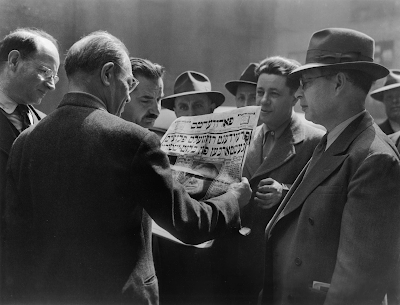
She was 19 and working in Manhattan as a photo printer for the Acme Newspictures agency when she photographed several men in Manhattan’s garment district in April 1945. One held up a copy of The Jewish Daily Forward, the Yiddish-language newspaper, as the others read about President Franklin D. Roosevelt’s death. Wyman’s “Looking East on 41st Street, NYC” (1947) down a canyon of skyscrapers captures the majesty and industry of the city.
“Men of the Garment District Read of President Roosevelt’s Death, NYC, 1945,” Ida Wyman. (Courtesy of Monroe Gallery)
Before Handelman Meyer and Wyman, women were often assigned to shoot department store openings, Monroe said.
In 1947, the Photo League appeared on a long list of organizations identified with the Communist Party. Efforts to counter the allegation included a large exhibition, “This Is the Photo League.” But in 1949, Angela Calomiris, a Photo League member and F.B.I. informant, publicly testified that members of the organization were Communists. The League disbanded in 1951, a casualty of the Red Scare.
The league’s secretary at the time, Handelman Meyer answered the office phone when requests for comment about the accusations poured in from the media. She also received threatening calls.
“It got to be too much,” she told The New York Times. “They were blacklisting people. There were photographers who could not get their passports for overseas jobs. Little by little, it dissolved.”
When the league closed, Handelman Meyer put her photos and negatives in boxes and moved on with her life. They wouldn’t be opened for many years.
In the early 1940s, the list of notable photographers who were active in the league or supported their activities also included Margaret Bourke-White, W. Eugene Smith, Helen Levitt, Farm Security Administration photographer Arthur Rothstein, Beaumont Newhall, Nancy Newhall, Richard Avedon, Weegee, Robert Frank, Harold Feinstein, Ansel Adams, Edward Weston and Minor White.
‘Two Pioneering Women Photographers of the Photo League’
Sonia Handelman Meyer and Ida Wyman
WHEN: Through June 18
WHERE: Monroe Gallery of Photography, 112 Don Gaspar Ave., Santa Fe
CONTACT: 505-992-0800, monroegallery.com
March 11, 2023 1-2 PM
International Center of Photography & Online
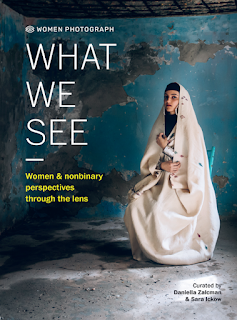
Women Photograph, a global organization dedicated to elevating the voices of women and nonbinary visual journalists celebrates its new publication, What We See: Women & Nonbinary Perspectives Through the Lens.
Sara Ickow, Exhibitions & Special Projects for Women Photograph and Senior Manager of Exhibitions and Collections at ICP, will lead a conversation with Women Photograph founder Daniella Zalcman and photographers Nina Berman and Kholood Eid centered on the new publication as well as the importance of representation resources within the field.
About the Book
Open your eyes to a new world view with 100 women and nonbinary photojournalists’ stories from behind the lens.
85% of photojournalists are men. That means almost everything that is reported in the world is seen through men’s eyes. Similarly, spaces and communities men don’t have access to are left undocumented and forgotten. With the camera limited to the hands of one gender, photographic ‘truth’ is more subjective than it seems. To answer this serious ethical problem, Women Photograph flips that bias on its head to show what and how women and nonbinary photojournalists see.
From documenting major events such as 9/11 to capturing unseen and misrepresented communities, this book presents a revisionist contemporary history: pore over 50 years of women’s dispatches in 100 photographs. Each image is accompanied by 200 words from the photographer about the experience and the subject, offering fresh insights and a much-needed perspective.
Until we have balanced, representative reporting the camera cannot offer a mirror to our global society. To get the full picture, we need a diverse range of people behind the lens. This book offers a first step.
Relearn how to see with this evergreen catalogue that elevates the voices of women and nonbinary visual storytellers.
This event is free with museum admission. This program is being offered both in person at ICP, located on NYC's Lower East Side, and online.
International Center of Photography & Online
79 Essex Street, New York, NY 10002
More about the book here.
March 17, 2021
March 5, 2021
By Michael Abatemarco
The golden age of street photography, photojournalism, and documentary photography lasted from the 1930s to the 1950s. It was an era that saw the birth of a number of influential photography agencies and collectives, including Magnum, founded in Paris in 1947, and New York’s Photo League, founded in 1936. Many of their number were among the most respected photographers of their day, including Magnum’s Henri Cartier-Bresson and the Photo League’s Paul Strand and Arthur Leipzig.
Most of the images that came out of the era were in black and white, partly because color printing was more expensive and less stable, and most news agencies and magazines only printed in black and white. “Color negates all of photography’s three-dimensional values,” claimed Cartier-Bresson.
Ida Wyman: East Harlem, 1947 in Color is a selection of 14 photographs on exhibit at Monroe Gallery drawn from a series called Lost Ektachromes. The photographer, who was a member of the league, came across the negatives sometime around 2010. They remained undeveloped until then because Wyman, who was proficient at printing in black and white, lacked the expertise to do her own color printing. She needed to find someone she could trust who could print them with fidelity and under her supervision.
“She was already in her 80s,” says Wyman’s granddaughter Heather Garrison, who manages the estate. “She always said she wanted to do an exhibit on this work. And as we catalogued it, we found additional pieces.”
Wyman (1926-2019) was “no slouch,” says Michelle Monroe, co-owner of Monroe Gallery of Photography, adding that she shot more than 100 assignments for Life magazine throughout her career as a freelance photographer. Her work exemplified the cooperative’s focus on capturing the human condition in America’s urban and rural settings at mid-century.
“It was really one of the first movements to use photography as a social documentary tool,” says gallery co-owner Sidney Monroe.
The work in the show includes portraits, street scenes, and candid images of people. Some are street vendors selling their wares. Some sit on stoops engaged in conversation, and some are merely walking or otherwise going about their day. As a whole, it’s a simple snapshot of life in the city.
The Key Maker, East Harlem, 1947
East Harlem was a neighborhood of immigrants and the working class poor. As a photographer, she had an ethos in line with that of the Photo League, although she was not yet a member at the time the photos were taken. And none of them were shot as an assignment but purely to indulge her own enthusiasm for the medium. Wyman was also experimenting with a new kind of film. Ektachrome was only developed in the early 1940s. The work languished in her archives, in part because Wyman never achieved the notoriety of her contemporaries until late in life, and she was never focused on showing her work publicly in galleries or museums.
“Ms. Wyman — whose work for Life, Look and other magazines went largely unheralded for decades — discovered what she called a ‘special kind of happiness’ in photographing subjects like a little girl wearing curlers, a peddler hauling a block of ice from a horse-drawn cart and four boys holding dolls, pretending to be the plastic girls’ fathers,” wrote Richard Sandomir in Wyman’s New York Times obituary (“Ida Wyman, Whose Camera Captured Ordinary People, Dies at 93”). Perhaps that’s because Wyman, like many of the subjects she photographed, came from a working-class family. Her parents were Jewish immigrants in Malden, Massachusetts, who later owned a small grocery store in the Bronx.
Soon after graduating from high school in 1943, Wyman started working in the mailroom at Acme Newspictures. Eventually, she was promoted to photo printer. Her intention was to spend a year working before starting nursing school. “She was always fascinated by science and medicine,” Garrison says of Wyman, who got her first box camera at 14. But in the interim, her love of photography superseded other ambitions.
Wyman spent her earnings on film and processing. “On her lunch breaks and in her spare time she just loved to walk the city and take pictures,” Garrison says. “Then she would have a body of work that she could show.” Determined to land assignments, she reserved these bodies of work to show to editors.
Wyman had no job security at Acme. When the men came back from the war, Wyman and women like her were out of a job.
However, her career in photography was just beginning.
The Shoe Shine Man, East Harlem, 1947
Over the course of the next six years, she worked as a freelancer, taking assignments for Fortune, Look, Life, and Parade, among other publications. “She had the usual soft assignments, like for the Saturday Evening Post,” Michelle Monroe says. “If there was a grocery store opening, ‘send the woman.’ She wasn’t picky. She wanted the work. I think it was very hardscrabble working as a woman without the affiliation of a publication directly.”
But Wyman was motivated. Garrison says she landed assignments through sheer perseverance. “I give her a lot of credit, a young girl — 18, 19, 20, 21 — especially in a man’s world, walking into these offices and self-advocating,” Garrison says.
Wyman was encouraged to join the Photo League on the advice of her husband, photographer Simon Nathan, but in the early 1950s, the demands of family life temporarily curtailed her career. When she returned to photography in the 1960s, it was as a photographer in medical fields. She was chief photographer at the department of pathology at Columbia University’s College of Physicians and Surgeons from 1968 until 1983 when she returned to freelancing.
“Her varied assignments always focused on human interest stories, which have become a hallmark of her work,” Garrison says.
That’s what we see in her black-and-white photographs, but also in the Ektachromes. And like her monochromatic work, the contrasts are stark, the shadows deep and rich, befitting, perhaps, the work of one who’s not used to shooting in color. The palette is muted, giving them the appearance of hand-colored photographs, a technique that was common since the early days of photography. And they weave a similar kind of nostalgic spell. But unlike hand-coloring, their ethereal and dreamlike quality, says Michelle Monroe, was due in part to the city’s pollution.
The stringless banjo, East Harlem, 1947
“Most cities in, say, like the 1920s through the 1960s, were powered by coal,” she says. “There’s a lot of diffused light. Coal hung around the lower city so much. There’s such a softening of the air from that particulate. Margaret Bourke-White taught us that — not directly, but in studying her work.”
But it’s the joyous aspects of the familiar and the sense of commonality that also make them captivating.
“She always had an eye for people,” Garrison says. “She loved to connect with people, and I think that’s what made her photos so wonderful.”
details
Ida Wyman: East Harlem, 1947 in Color
Through April 11
Monroe Gallery of Photography, 112 Don Gaspar Ave., 505-992-0800, monroegallery.com