Wednesday, September 16, 2026
The Monuments: Who Should Shape Public Space New exhibit features photographs by Sanjay Suchak
Saturday, September 5, 2026
Ania Hull: Beyond the beauty of Indian Market, deeper stories emerged
Via The Santa Fe New Mexican Pasatiempo
August 21, 2026
The 104th Indian Market broke me, but in a good way — in a way that only too much time in the sun and heat surrounded by so much beauty and so much storytelling you don’t know where to look and what story to hear next can.
There was also plenty of hurt under the surface. Plenty of stories that brought me back to reality and showed me so much beyond the gorgeous art displayed by almost 1,000 artists at the annual market...
After Indian Market was over, I had the opportunity to interview Sid Monroe, co-owner of the Monroe Gallery of Photography, and to visit the new exhibition of photographs by Eugene Tapahe (DinĂ©), one of the artists who’s been a presence at Indian Market for some years now. The photographs show, among other things, scenes from Standing Rock and Minneapolis.
Sid and I discussed the lessons we — non-Indigenous, white people — should all learn from how Indigenous people come together to support each other, once again, as Indian Country. While this may be something new to us, to have to stand up to the government and to realize that we are being lied to, it’s not new for Indigenous people, nor to Black people, nor to other ethnic groups that have suffered so much we can’t even imagine what that means.
I’ll leave you with this, though: stand up for each other, especially for people who don’t have your privilege. I’ve written about it and will continue writing about it. -Ania Hull
Wednesday, September 2, 2026
9/11 In Remembrance 25 Years Later
Monroe Gallery of Photography announces a special Pop Up exhibition of photographs commemorating the 25th anniversary of the terrorist attacks on the World Trade Center that became known as 9/11. The Pop Up is at Monroe Gallery, 112 Don Gaspar Avenue September 9-13, 2026.
Every year since 2001 solemn ceremonies are held to remember the many that lost their lives, the families whose lives were changed forever, and the selfless first responders who performed heroically on that day, and for days after, in the search for survivors.
The twin towers design process started in 1965 and construction began in 1972. The twin towers were the tallest buildings in the world for a very short time. Photographs in the exhibit document the construction of the World Trade Center, its prominence in the skyline of Manhattan, and the devastation of September 11, 2001
Sidney and Michelle Monroe relocated their family and Gallery from New York City to Santa Fe shortly after 9/11. This exhibit is a remembrance of the World Trade Center, fellow New Yorkers, and the countless lives affected on that day.
Monday, August 31, 2026
Joe McNally - Faces of Ground Zero: 25 Years Later
Joe McNally shares the story behind his powerful portraits of 272 lives changed by 9/11
Please join us for a very special night in honor of the 25th Anniversary of 9/11.
The Faces of Ground Zero, which are life-sized, giant Polaroids, was created by photographer Joe McNally in the immediate aftermath of the tragedy. Working out of a special studio housing the camera, a highly specialized instrument, he photographed 272 people whose lives intersected in profound fashion with 9/11.
Firefighters, police officers, medical personnel, iron workers, volunteers, families—all came to the camera to have their story told in pictures and their own words. The Giant Polaroids, framed, stand roughly 9 feet tall and 4 feet wide. They toured the US and internationally, became a book, and assisted in raising approximately $2 million for the 9/11 relief efforts.
The project is now on view, installed permanently in the 9/11 Memorial Museum, but for one night only, join us in-store to see a limited amount of the giant Polaroids up close!
On the 25th Anniversay Joe McNally will be at Adorama in a special appearance to discuss the creation of this project, and the emotional story of how these pictures were made.
Monday, July 13, 2026
Alfred Eisenstaedt is the focus of a dual exhibition in Abano Terme and Venice
July 13, 2026
"An exhibition dedicated to one of the great figures of 20th-century photography brings together two cultural institutions in the Veneto region through a complementary exhibition that traces the life and work of Alfred Eisenstaedt (Tczew, 1898 – Oak Bluffs, 1995). Through September 20, 2026, the Villa Bassi Rathgeb Museum in Abano Terme is hosting the exhibition *Alfred Eisenstaedt: Photography Was in the Air*, while the story continues through November 22 at the Naval History Museum in Venice with a second exhibition dedicated to the photographer’s years in Europe.
The initiative, curated by Monica Poggi and produced by CAMERA – Italian Center for Photography, is organized by the Municipality of Abano Terme and D’Uva, the operator of MUNAV – the Naval History Museum of Venice. The project was conceived with the aim of fostering dialogue between institutions and the local community through the work of an artist who made a decisive contribution to defining the language of contemporary photojournalism. The exhibition’s title draws on Eisenstaedt’s own reflections on post-World War I Germany and evokes the atmosphere of transformation, cultural openness, and creative energy that shaped his formative years—an atmosphere the organizers aim to bring to life through this dual exhibition itinerary.
Considered one of the most important photographers of the 20th century, Alfred Eisenstaedt is best known for being one of the leading visual contributors to Life magazine and the creator of one of the most famous images in the history of photography, the famous “V-J Day in Times Square,” the photograph taken on August 14, 1945, during the celebrations marking the end of World War II, which captures a sailor kissing a nurse in the heart of New York."
Sunday, October 19, 2025
Photojournalist Ed Kashi on his career-spanning exhibition at Monroe Gallery
October 19, 2025
In a Turkish terrorist court in Diyarbakir, this Kurdish woman was sentenced to 13 years in prison, accused of belonging to the Kurdistan Workers Party, or PKK, which seeks to create an independent state in southeastern Turkey, 2006
Even people who don’t know Ed Kashi’s name are often familiar with his photographs. Over the course of his nearly 50-year career, the award-winning photojournalist has created memorable long-form photo-essays for National Geographic, and his work has been published in Time, Newsweek and The New York Times. The World Photography Organisation has called him “one of the leading and most innovative photojournalists of our time.”
Kashi’s current, career-spanning exhibition at Monroe Gallery of Photography in Santa Fe, “Ed Kashi: A Period in Time,” is also the title of his most recent book. The exhibition runs through Nov. 16.
One of Kashi’s most compelling images from that series was taken at a military tribunal in Diyarbakir, Turkey. A fashionably dressed Kurdish woman, accused of being a member of the outlawed Kurdistan Workers’ Party (PKK), stands at a cage-like witness stand, a handful of armed military men behind her.
“I think I got in because I was following a Kurdish human rights lawyer, so I sort of traipsed into the courtroom with him and made a few pictures. And that ended up being a very significant image,” Kashi said. “But after that image appeared in the magazine, they (the Turkish government) confiscated all the copies of (that) 1992 issue of National Geographic within Turkey.”
Despite the attempted censorship, that image, and others from the series, reached a wide international audience. Kashi credits those images with bringing much greater attention to the persecution of the Kurds, a subject that had previously gone underreported.
The Turkish government, meanwhile, grew increasingly restrictive on press freedom. Government repression is an ever-present challenge for photojournalists around the world, Kashi said, and something he has contended with many times.
“For journalists, and particularly for photographers, there is a constant battle of how much can we get away with. How close can we get? What can we access? And when that gets shut down, we have to find other ways to gain access,” he said.
The global landscape for press freedom has gotten significantly worse in recent years, according to Kashi, with widespread and concerted attacks on journalists that he calls “unprecedented.”
“Look at our own Pentagon and the restrictions they’re trying to place on the media,” Kashi said. “It’s a very interesting and tricky moment right now for the media in general, all around the world. There’s been an increase in journalists being arrested, imprisoned and in some cases killed, particularly in Gaza.”
Although Kashi said he has sometimes risked his life for stories, he was never deliberately targeted, the way he said some journalists are currently being targeted and killed in places such as Gaza and Ukraine.
“I’ve not worked in Ukraine, but a colleague of mine, who works a lot with the New York Times as a photographer, was just saying, the scariest thing is when you’re driving down a highway and you hear a drone overhead. It’s not even about (accidentally being hit by) missiles or bombardment from planes or artillery. It’s that a drone can take your car out because they suspect you of being the enemy, or they just want to,” Kashi said. “They know you’re a journalist. They wanted to target you.”
Despite the dangers, photojournalists continue doing their jobs, Kashi said, because they know it can change people’s hearts and minds. Kashi has seen the far-reaching impact his own work has had, and he hopes it will inspire others.
“If you tell good stories, and you tell them in an authentic and sincere way, you can reach people. You can penetrate their consciousness,” Kashi said. “And whether they donate money, or they get involved through their actions, or, at the very least, you might change their mind about something. That’s the reason we must do this work.”
Tuesday, July 29, 2025
The Palazzo Magnani Foundation in Reggio Emilia presents the exhibition Margaret Bourke-White: The work 1930-1960
July 27, 2025
From October 25, 2025 to February 8, 2026, the frescoed halls of the Chiostri di San Pietro in Reggio Emilia will host Margaret Bourke-White. The Work 1930-1960, a retrospective exhibition dedicated to Margaret Bourke-White (New York, 1904 - Stamford, 1971), one of the most significant figures in twentieth-century photography. The initiative is promoted by the Fondazione Palazzo Magnani in collaboration with CAMERA - Italian Center for Photography, and curated by Monica Poggi. The exhibition presents 150 images spanning three decades of the author’s activity, including industrial reportage, war scenarios, social transformations and geopolitical conflicts. Born in New York in 1904 and passed away in 1971, Bourke-White was able to build an international career distinguished by her ability to deal with extreme contexts, both in terms of logistical difficulties and political implications, establishing herself as a direct witness to the events that marked the century. The exhibition is divided into six sections, following a chronological and thematic criterion, including industrial reportage, conflict and major social transformations. Click to read full article
Related article: Margaret Bourke-White. The work 1930-1960
Friday, November 29, 2024
Images of Winter Are Frozen in Time
November 29, 2024
In the 2023 photograph Ancestral Strength by Eugene Tapahe, four Indigenous women — Cayuse, Umatilla, Newe Sogobia, and TsĂ©stho’e — stand side by side wearing brightly colored traditional garb, staring toward the sky behind the photographer. The stark winter beauty of the background in Wyoming’s Teton National Park further highlights the women’s projected power.
In the 1949 photograph Southern Pacific Steam Engine by John Dominis, a steam engine plows through a snowy landscape at Donner Pass, California.
Both images showcase forms of strength, but that’s not the tie that binds them. Both are part of Frozen in Time, an exhibition that Monroe Gallery of Photography describes as an “imaginative survey of compelling images.” It covers a range of human experiences, from the joy of exploration in George Silk’s 1946 shot Tourists Climb Fox Glacier in Tasman National Park, taken in New Zealand, to the ugly brutality of war in Tony Vaccaro’s White Death, Pvt. Henry Irving Tannebaum Ottre, taken in Belgium in 1945.
It opens with a reception from 4-6 p.m. Friday, November 29. — Brian Sandford
details
Through January 19
Monroe Gallery of Photography
112 Don Gaspar Avenue
505-992-0800, monroegallery.com
Wednesday, November 27, 2024
New Exhibition "Frozen In Time" Opening and Plaza Holiday Lighting Will be Held Nov. 29
The new exhibition "Frozen In Time", an imaginative survey of compelling images that reveal moments in history and the unseen and unexpected layers of our world in winter, opens with a public reception on Friday, November 29, from 4-6 pm.
The City of Santa Fe’s annual Holiday Plaza Lighting ceremony will be held from 4:15-8 p.m. Nov. 29 on The Plaza.
Santa and Mrs. Claus will arrive by vintage fire truck at 5:45 p.m. City officials will switch on the lights at 6:30 p.m., and Santa Fe’s holiday season will officially begin.
Food Trucks
Countdown to Lighting
Friday, May 17, 2024
Out There: When I’m (19)64
May 17, 2024
Not to make anyone feel elderly, but the 1960s are now more than 60 years old.
That startling fact leaps to the fore when one considers Monroe Gallery of Photography’s newest exhibit, simply titled 1964. The gallery calls it the year the 1960s truly began, complete with inflection points such as the musical British Invasion, Muhammad Ali becoming the world heavyweight boxing champion, and the slayings of three civil rights workers in Mississippi.
Several images show fans in states of euphoria over seeing — or preparing to see — The Beatles. In Bill Eppridge’s The Beatles With Ed Sullivan, about a dozen men hold cameras to document the band’s every move. It’s not unlike fans in 2024 using cellphones for the same purpose. In Bob Gomel’s Black Muslim leader Malcolm X Photographing Cassius Clay, Ali hams it up, while the usually stoic civil rights figure grins behind the camera. In Eppridge’s Kent Courtney, National Chair of the Conservative Society of America, Courtney tightens his tie, cutting a powerful image of buttoned-up status quo conformity.
The gallery will host a talk with Amalie R. Rothschild, a filmmaker and photographer who has created documentaries about social issues, at 4:30 p.m. June 8. — B.S.
details
Through June 23
Monroe Gallery of Photography
112 Don Gaspar Avenue
505-992-0800; monroegallery.com
Sunday, April 21, 2024
Monroe Gallery at the 43rd edition of The Photography Show,
Monroe Gallery of Photography is delighted to announce its participation in the highly anticipated 43rd edition of The Photography Show, the longest-running and leading fair dedicated to photography, returning this year to the iconic Park Avenue Armory in New York City from April 25 to 28, 2024.
Marking an exciting homecoming for The Photography Show, this edition promises a spectacular showcase of photography. The expansive Armory space will host 77 exhibiting galleries and a dedicated photobook sector, creating a unique and exciting experience for collectors and enthusiasts alike.
The Photography Show, located at 643 Park Ave, New York, NY 10065, will open its doors with a VIP Preview on Thursday, April 25, followed by the official opening on Friday, April 26, at 12 pm. That evening, the fair will feature a Night of Photography from 5 pm to 8 pm, providing a unique evening experience. On Saturday, April 27, and Sunday, April 28, the show will be open to the public from 12 pm to 7 pm and 12 pm to 5 pm, respectively.
Monroe Gallery of Photography will be located at Booth A52 and will exhibit a curated selection of important contemporary photojournalism, with a central focus on Sanjay Suchak's “Take Them Down” project documenting the deinstallation and repurposing of monumental Confederate statues along with photographs Mark Peterson made at the Robert E. Lee monument in Richmond, Virginia in 2020. Other issues addressed by Gallery photojournalists in our exhibit will include climate change, women’s rights, and the 2016 Standing Rock protest movement to stop the Dakota Access pipeline. The Gallery will also have a special selection of fashion, WWII, and portrait photographs by Tony Vaccaro, who passed away in December 2022 at the age of 100 and who was a frequent presence in the Monroe Gallery booth through past AIPAD Shows.
We look forward to seeing you in our booth #A52! Please email us with any questions. Preview our exhibition here.
Saturday, April 13, 2024
AIPAD Exposure Newsletter: The Photography Show Highlights
| Via AIPAD Exposure Newsletter April 11, 2024 |
|
|
|
|
|
Thursday, February 29, 2024
Greenwich Historical Society Exhibit Features 6 Women Photographers Whose Iconic Images for LIFE Magazine Helped Create Modern Journalism
Via Greenwich Free Press
Six pioneering women whose photographs for LIFE magazine skillfully captured events on a quickly evolving world stage will be the subject of Greenwich Historical Society’s new exhibition to debut March 6. These photographers enabled the public “to see life; to see the world; to eyewitness great events,” as described by LIFE magazine founder and editor-in-chief Henry Luce.
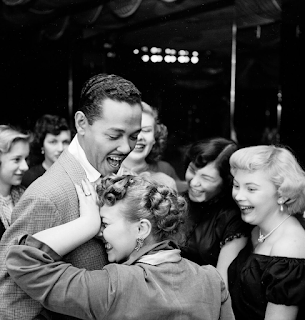
Martha Holmes, photograph from “Mr. B.,” LIFE, April 24, 1950 © LIFE Picture Collection, Dotdash Meredith Corp. Martha Holmes began photographing for LIFE in 1944. On view in the exhibition are Holmes’s 1950 photographs of mixed-race singer Billy Eckstine, including one of Eckstine being embraced by a white fan—a provocative image that Holmes felt was one of her best because she felt that it “told just what the world should be like.” Henry Luce supported this opinion.
LIFE: Six Women Photographers features iconic images from these talented women who helped create modern photojournalism through their work as featured in the pages of LIFE magazine.
On view through July 7, 2024, the exhibition presents more than 70 photographs by Margaret Bourke-White (1904-1971), Marie Hansen (1918-1969), Martha Holmes (1923-2006), Lisa Larsen (ca. 1925-1959), Nina Leen (ca. 1909-1995) and Hansel Mieth (1909-1998).
“We are thrilled to showcase the works of these talented photographers who were on the vanguard of a transformative change in how twentieth-century Americans received and understood global cultural and political events,” said Maggie Dimock, curator of exhibitions and collections at Greenwich Historical Society.
“This insightful exhibition offers a glimpse into how each of these remarkable women used their camera to capture topics that dominated American discourse through the last century, including U.S. industrial strength, the role of women and the family in modern American society, race relations, World War II, labor movements and the Cold War.”
A long-time Greenwich resident, Henry Luce (1898 – 1967) was convinced that American political, economic, and cultural power would, and should, dominate the era and that photojournalism, or “photo essays” as he coined them, could effectively shape America as an international power, inspiring its people, in his words, “to live and work and fight with vigor and enthusiasm.”
For decades, Americans saw the world through the lens of the photographers at LIFE, and the magazine’s innovative photo essays became the publication’s trademark.
Of the 101 photographers on staff at LIFE during the magazine’s run as a weekly, only six full-time photographers were women. LIFE: Six Women Photographers highlights the work of these photographers while providing insight into the process through which they worked with editors to create visual stories, through the inclusion of photographs, vintage prints, copy prints and contact sheets. Published and unpublished photographs along with select memos, correspondence and other items from Time Inc. records show the editing process behind the final, published stories.
“The topic will provide fascinating historical context to the enormous changes underway today in media,” said Greenwich Historical Society Executive Director and CEO Debra Mecky. “And it will enable us to further our mission to strengthen the community’s connection to our past, to each other and to our future. Henry Luce was a Greenwich resident during the time he was arguably the most influential media figure in the twentieth century and one of the country’s most prominent citizens.”
LIFE: Six Women Photographers has been organized by the New-York Historical Society. The exhibition is curated by Marilyn Satin Kushner, curator and head, Department of Prints, Photographs, and Architectural Collections; and Sarah Gordon, curatorial scholar in women’s history, Center for Women’s History; with Erin Levitsky, Ryerson University; and William J. Simmons, Andrew Mellon Foundation Pre-Doctoral Fellow, Center for Women’s History. The New-York Historical Society holds the research archive of Time Inc., which was acquired by the Meredith Corporation (now Dotdash Meredith Corp.) in 2018.
A series of lectures, workshops and discussions, film screenings and other activity related to the exhibition will be presented by Greenwich Historical Society throughout the duration of the exhibition, beginning with two in March:
Women of Photos and Letters: Margaret Bourke-White, Clare Booth Luce and Annie Leibovitz
Thursday, March 14 from 6:00 – 7:00 pm
In honor of Women’s History Month, Louisa Iacurci of the Connecticut Women’s Hall of Fame will explore the inspiring histories of Hall of Fame inductees whose work and lives are intertwined with social advocacy and journalistic activism, including photographers Margaret Bourke-White and Annie Leibovitz and writer, journalist and politician Clare Booth Luce.
LIFE: Six Women Photographers: A Lecture with Curator Marilyn Satin Kushner
Thursday, March 21 from 6:00 – 7:00 pm
In an illustrated lecture, Dr. Marilyn Satin Kushner, Curator and Head of the Department of Prints, Photographs, and Architectural Collections at New-York Historical Society, will expand on the curatorial process for LIFE: Six Women Photographers.
The full program schedule is available online: https://greenwichhistory.org/life-six-women-photographers/
Guided Gallery Tours:
Tours will be offered on select Sundays through June, from 1:00 – 1:30pm. Free with admission, participants will enjoy an in-depth docent-led discussion of LIFE: Six Women Photographers, that shares insightful interpretation of the photographs on view, and a modern perspective to understanding the complex social backdrop in which they would have originally been seen by magazine readers.
Dates: March 10, 24; April 7, 21; May 5, 19; June 2, 16, 30.
For more information: https://greenwichhistory.org/event/guided-gallery-tour/.
Margaret Bourke-White, photograph from “Franklin Roosevelt’s Wild West,” LIFE, November 23, 1936 © LIFE Picture Collection, Dotdash Meredith Corp. Margaret Bourke-White became one of the first four staff photographers at LIFE in 1936.
This exhibition has been generously supported by Joyce B. Cowin, with additional support from Sara Lee Schupf, Jerry Speyer, Robert A.M. Stern and Northern Trust.
Support for this exhibition at the Greenwich Historical Society has been generously provided by Josie Merck and annual donors to the Greenwich Historic Trust.
Tuesday, February 27, 2024
Upcoming Exhibition at Montclair Art Museum: Ed Kashi - Abandoned Moments
Ed Kashi: Abandoned Moments
MARCH 22-MAY 19, 2024
For Ed Kashi, the abandoned moment is the consequence of a fractional instant of surrender. The photographs in this exhibition, made over a 40-year period across four continents and in both black and white and color, reveal glimpses of transitory events filled with frenetic energy–the chaos of everyday life. Embodying photography’s intrinsic power, they preserve moments that can never occur again in exactly the same time and space. In these photographs, geometry, mood, and possibility unite to create something new and magical, capturing the untamed energy of a moment with abandon.
ARMENIA, COLOMBIA, 1981, From Ed Kashi Abandoned Moments. Archival pigment print, 20 x 24 in. Photograph courtesy of the artist.
Ed Kashi is a renowned photojournalist, filmmaker, speaker, and educator who has been making images and telling stories for 40 years. His restless creativity has continually placed him at the forefront of new approaches to visual storytelling. Dedicated to documenting the social and political issues that define our times, a sensitive eye and an intimate and compassionate relationship with his subjects are signatures of his intense and unsparing work. As a member of VII Photo, Kashi has been recognized for his complex imagery and its compelling rendering of the human condition.
Along with numerous journalism and photography awards and commissions, Kashi’s images have been published and exhibited worldwide. His photographs are in the collections of a number of major museums, including the George Eastman House, the International Center of Photography, the Museum of the City of New York, The Museum of Fine Arts Houston, and the New Orleans Museum of Art. His editorial assignments and personal projects have generated fourteen books.
Kashi is also a noted teacher, running photography workshops and master classes across the world. He will be offering a master workshop through the Yard School of Art beginning on April 7.
This exhibition, consisting of 29 photographs, is organized by MAM’s Executive Director, Ira Wagner.
3 South Mountain Avenue
Montclair, New Jersey 07042-1747
Thursday, June 1, 2023
Harwood Museum of Art Centennial
On view at the Harwood from June 2023 to January 2024, the Harwood Museum of Art Centennial exhibition will take visitors on a journey through the museum’s rich history. Touchstones will include the cultural history of the land where the museum now stands, and the many roles the property has served since it was purchased by Burt and Lucy Harwood in 1916. The property was the site for Taos’ first library and art gallery, including a permanent art collection from donors such as Mabel Dodge Luhan. It housed the Works Progress Administration’s (WPA) Taos County Project, the University of New Mexico Summer Field School of Art, and served as a nexus for the Taos Moderns.
The Harwood Museum of Art Centennial exhibition is a survey of the museum through time, the history of the town to which it is so central, and the role that art from Taos and its surroundings played in the larger artistic movements of the last century. Through unique historic and contemporary exhibition vignettes, the Centennial is a dynamic chance for guests to understand the evolution of one of the Southwest’s oldest museums. With a focus on the future, contemporary artists will be showcased through a series of community art installations and a juried artist commission.
Monroe Gallery of Photography is honored to have loaned a print by Margaret Bourke-White for the exhibition.
Margaret Bourke-White/©Life Picture Collection: Acoma Pueblo, New Mexico, (for TWA), 1935Sunday, April 23, 2023
Capturing Humanity: Photography exhibit explores snapshots of New York’s ordinary people
Sunday, April 23, 2023
Two pioneering women photographers who were blacklisted by the Red Scare share wall space at Santa Fe’s Monroe Gallery of Photography.
Both Sonia Handelman Meyer and Ida Wyman were members of the Photo League. The league was a collective of photographers active from 1936-1951, who believed their work could change poor social conditions and champion photography as an art form. It thrived as one of the most progressive, dynamic and creative centers for photography in the country. About one-third of its members were women.
Handelman Meyer and Wyman roamed the streets of New York, capturing the humanity of ordinary people. In some ways, their gender helped them remain invisible to the people they photographed.
“There was a great advantage to being a woman at that time, to be considered as no consequence,” gallery co-owner Michelle Monroe said.
Handelman Meyer learned about socially engaged photography in workshops by one of the Photo League founders Sid Grossman.
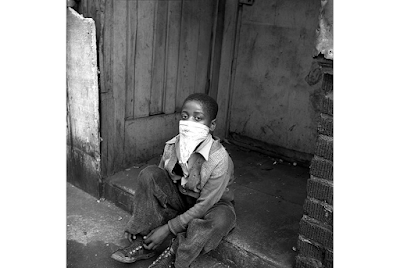
She captured three boys affecting tough guy poses after chasing her down the streets of Spanish Harlem demanding that she photograph them. She also shot “Boy Wearing Mask, New York City” (1946-1950), an image less mysterious that it seems.
“He was playing cops and robbers,” Monroe said. “The way he’s looking at her; there’s a lot of ambiguities about that child. Was he playing? Is it mistrust? Was it just an interruption from an adult? He’s just playing.”
Wyman photographed for Life and Business Week magazines, as well as her own enjoyment. Her work went unheralded for decades.
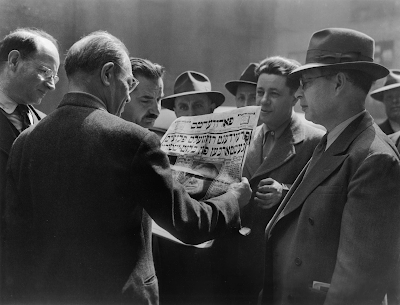
She was 19 and working in Manhattan as a photo printer for the Acme Newspictures agency when she photographed several men in Manhattan’s garment district in April 1945. One held up a copy of The Jewish Daily Forward, the Yiddish-language newspaper, as the others read about President Franklin D. Roosevelt’s death. Wyman’s “Looking East on 41st Street, NYC” (1947) down a canyon of skyscrapers captures the majesty and industry of the city.
“Men of the Garment District Read of President Roosevelt’s Death, NYC, 1945,” Ida Wyman. (Courtesy of Monroe Gallery)
Before Handelman Meyer and Wyman, women were often assigned to shoot department store openings, Monroe said.
In 1947, the Photo League appeared on a long list of organizations identified with the Communist Party. Efforts to counter the allegation included a large exhibition, “This Is the Photo League.” But in 1949, Angela Calomiris, a Photo League member and F.B.I. informant, publicly testified that members of the organization were Communists. The League disbanded in 1951, a casualty of the Red Scare.
The league’s secretary at the time, Handelman Meyer answered the office phone when requests for comment about the accusations poured in from the media. She also received threatening calls.
“It got to be too much,” she told The New York Times. “They were blacklisting people. There were photographers who could not get their passports for overseas jobs. Little by little, it dissolved.”
When the league closed, Handelman Meyer put her photos and negatives in boxes and moved on with her life. They wouldn’t be opened for many years.
In the early 1940s, the list of notable photographers who were active in the league or supported their activities also included Margaret Bourke-White, W. Eugene Smith, Helen Levitt, Farm Security Administration photographer Arthur Rothstein, Beaumont Newhall, Nancy Newhall, Richard Avedon, Weegee, Robert Frank, Harold Feinstein, Ansel Adams, Edward Weston and Minor White.
‘Two Pioneering Women Photographers of the Photo League’
Sonia Handelman Meyer and Ida Wyman
WHEN: Through June 18
WHERE: Monroe Gallery of Photography, 112 Don Gaspar Ave., Santa Fe
CONTACT: 505-992-0800, monroegallery.com
Saturday, March 25, 2023
Monroe Gallery announces representation of the Sonia Handelman Meyer estate
March 25, 2023
SANTA FE, NM.- Monroe Gallery of Photography has announced its representation of the Sonia Handelman Estate, and will exhibit a selection of lifetime and vintage prints at the 2023 AIPAD Photography Show in New York City March 31-April 2 and present a 2-person exhibit with Ida Wyman: “Pioneering Women of The Photo League” at Monroe Gallery in Santa Fe, April 21-June 18, 2023.
The Photo League was a collective of photographers active between 1936-1951 who believed their work could change poor social conditions and champion photography as an art form in the process. The Photo League thrived as one of the most progressive, dynamic and creative centers for photography in America, and was unusual in its time as many of the collective’s members were women. In the 1940s when McCarthyism started gathering momentum in the US, suspicious authorities decided to clamp down on the Photo League’s confrontational and uncensored representations of urban American society. In 1948, it was declared a subversive organization and blacklisted. As the league’s secretary at the time, Sonia Handelman Meyer answered the office phone when requests for comment about the accusations poured in from the media. “It got to be too much,” she told The New York Times. “They were blacklisting people”.
Sonia Handelman was born on Feb. 12, 1920, in Lakewood, N.J., and grew up in New York City. Her parents were Jewish immigrants from Eastern Europe. After graduating college in 1941, Handelman Meyer worked during World War II in the Office of War Information for the U.S. Signal Corps in Puerto Rico, and the Office of War Information in New York, and then at a news photography agency. In 1943 she joined the Photo League, where she studied with John Ebstel and Sid Grossman. She also served as secretary (the only paid position at the League) and, in 1948-50, as chair of the Hine Committee. She participated in several group exhibitions, including "This Is the Photo League" (1948–49). Handelman Meyer collaborated with Morris Huberland on a photographic series of Sydenham Hospital in Harlem (1947) and photographed in neighborhoods throughout New York. She later documented the Weavers, the American folk group that included Pete Seeger. Her photographs appeared in The New York Times (1947–48) and U.S. Camera Annual (1947). Her photographs also appeared in the exhibition "Photographic Crossroads: The Photo League" at the International Center of Photography, New York (1978) and "The Women of Photo League" at Higher Pictures Gallery, New York (2009).
Sonia Handelman Meyer died on September 11, 2022, at her home in Charlotte, N.C., at age 102.
Sonia Handelman Meyer’s work went unrecognized for decades. In recent years, there has been a revived interest in the radical collective that contributed incomparably towards promoting early street photography as an art form.
Thursday, January 26, 2023
A show celebrating acclaimed photographer Tony Vaccaro at Santa Fe’s Monroe Gallery of Photography (112 Don Gaspar) can be viewed for five more days—through Jan. 29
January 25, 2023
Honoring Vaccaro
Speaking of countdowns, a show celebrating acclaimed photographer Tony Vaccaro at Santa Fe’s Monroe Gallery of Photography (112 Don Gaspar) can be viewed for five more days—through Jan. 29. Monroe mounted two exhibitions—here and a New York pop-up last month—to honor Vaccaro’s 100th birthday; the photographer died on Dec. 28, just eight days after his centennial, which he celebrated in New York with friends at a surprise birthday dinner.
A New York Times obituary recounts how Vaccaro became a war photographer in World War II—also the subject of a 2016 HBO documentary. After the war, he transitioned and began to make fashion, travel and celebrity photographs for the country’s leading magazines.
Those celebrities included Georgia O’Keeffe, whom Life magazine assigned Vaccaro to photograph in 1960. O’Keeffe expected a more famous photographer and at first refused to pose: “To win her over, Mr. Vaccaro cooked a meal and made a picnic lunch. When the weather turned too windy for the picnic, he gave her a plate of Swiss cheese as she sat in the back of his car. And when she playfully peered through a hole in a piece of the cheese, Mr. Vaccaro went into action,” the obituary reads. His other famous subjects included John F. Kennedy, Pablo Picasso and Sophie Loren, to name a few.
This quote from Vaccaro accompanies Monroe’s information on the exhibition: “We call each other German, French, Italian. There is no Italian blood. There is no French blood. It’s human blood. On this Earth there is one humanity. Let’s do something about it. Let’s live! In a way, photography was my way of telling the world, ‘We have better things to do than to kill ourselves.’”
Wednesday, December 28, 2022
Portraits from Three Exhibitions by Three American Photographers: Joel-Peter Witkin, Arthur Elgort, Tony Vaccaro
December 28, 2022
Friday, December 23, 2022
Tony Vaccaro centennial exhibition on view at Monroe Gallery of Photography
December 23, 2022
A glowing sunset portrait of the twin towers of the World Trade Center from 1979
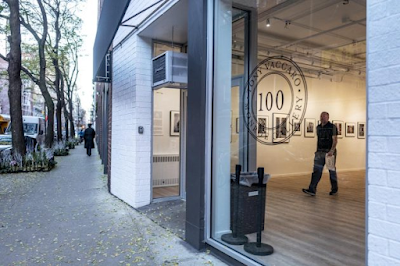
SANTA FE, NM.- A new exhibitions celebrates the 100th birthday of acclaimed photographer Tony Vaccaro in Santa Fe. The show has been on view at Monroe Gallery in Santa Fe since November 25, 2022, and will end on January 29, 2023.
Vaccaro is known for his photographs of WWII, which were the subject of a 2016 HBO documentary, and his editorial work for Life, Look, Newsweek, Vanity Fair and countless other publications. The exhibitions coincide with Tony Vaccaro 100! on view at the Museum fĂ¼r Photographie in Braunschweig, Germany. In both locations, Tony Vaccaro: The Centennial Exhibition, juxtaposes the living legend’s powerful war images with the lyrical mid-century fashion, film, and pop culture photographs that came later.
On view are more than four dozen photographs dating from 1944-1979. From the battlefields of Europe to the rooftops of Manhattan, Vaccaro trained his inimitable lens with a sensitivity derived from early hardship as an orphan in Italy. After the war, he replaced the searing images of horror embedded in his memory, by focusing on the splendor of life and capturing the beauty of fashion and those who gave of themselves: artists, writers, movie stars, and cultural figures. From a photograph of a running soldier in 1944’s Battle of the Bulge to a shot of the actress Gwen Verdon swinging in a hammock against a New York skyline, the exhibition illustrates Vaccaro’s will to live against all odds and to advance the power of beauty. Several never-before-exhibited photographs are on view: a 1951 image of a bevy of beautiful women surrounding one in a pink dress on a balcony, a 1968 shot of Vaccaro holding up a test strip during a photo shoot, and a glowing sunset portrait of the twin towers of the World Trade Center from 1979.
As Vaccaro passed his 100th birthday on December 20, 2022, he has survived two bouts of Covid, and is one of the few people alive who can claim to have survived the Battle of Normandy and Covid. He attributes his longevity to “blind luck, red wine and determination.”
“To me, the greatest thing that you can do is challenge the world,” said Vaccaro. “And most of these challenges I win. That’s what keeps me going.”
Born in Greensburg, Pennsylvania, on December 20, 1922, Michelantonio Celestino Onofrio Vaccaro spent the first years of his life in the village of Bonefro, Italy, after his family left America under threat from the Mafia. Both of his parents had died by the time he was eight years old, and he was raised by an uncaring aunt and a brutal uncle. His love of photography began in Bonefro where at age ten, he began taking pictures with a box camera. When World War II broke out, the American ambassador in Rome ordered Vaccaro to return to the States. He settled in with his sisters in New Rochelle, N.Y., where he joined his high school camera club. His teacher and mentor Bertram Lewis guided him through a year of concentrated apprenticeship.
A year later, at the age of 21, Vaccaro was drafted into the war. He was determined to photograph the war, and had his portable 35mm Argus C-3 with him from the start. By the spring of 1944 he was photographing war games in Wales. By June, now a combat infantryman in the 83rd Infantry Division, he was on a boat heading toward Omaha Beach, six days after the first landings at Normandy. For the next 272 days, Vaccaro fought and photographed on the front lines of the war. He entered Germany in December 1944, as a private in the Intelligence Platoon, and was tasked with going behind enemy lines at night. In the years after the war, he remained in Germany to photograph the rebuilding of the country for Stars and Stripes magazine.
Returning to the States in 1950, Vacarro started his career as a commercial photographer, eventually working for virtually every major publication: Flair, Life, Look, Harper’s Bazaar, Quick, Newsweek, Town and Country, Venture, and many more. Tony went on to become one the most sought after photographers of his day, photographing everyone from Enzo Ferrari and Sophia Loren to Pablo Picasso, Peggy Guggenheim and Frank Lloyd Wright. From 1970 to 1980 he taught photography at Cooper Union.
“Il Maestro,” as the Italian press calls him, has won numerous honors and awards. These include the Art Director’s Gold Medal (New York City, 1963), The World Press Photo Gold Medal (The Hague, 1969), The Legion of Honor (Paris, 1994), The Medal of Honor (Luxembourg, 2002), Das Verdienstkreuz (Berlin, 2004), and the Minerva d’Oro (Pescara, 2014).
Since retiring in 1982, Vaccaro’s work has been exhibited world-wide over 250 times and has been published or been the subject of ten books and two major films. In 2014, the Museo Foto Tony Vaccaro was inaugurated in Bonefro, Italy.
Vaccaro’s works are in numerous private and public collections including The Metropolitan Museum of Art in New York, the Georgia O’Keeffe Museum in Santa Fe, the Centre Pompidou in Paris, and the Library of Congress in Washington, DC.