December 15, 2025
They all also centered around a single issue: immigration. --click to read full report
Monroe Gallery of Photography specializes in 20th- and 21st-century photojournalism and humanist imagery—images that are embedded in our collective consciousness and which form a shared visual heritage for human society. They set social and political changes in motion, transforming the way we live and think—in a shared medium that is a singular intersectionality of art and journalism. — Sidney and Michelle Monroe
December 15, 2025
They all also centered around a single issue: immigration. --click to read full report
November 1, 2025
Via Fotoist International Photography Festival
October 17, 2025
Exhibition: "A Brief Guide to Investigating War Crimes” by Ron Haviv - VII Foundation / 17.10.2025 / 18:00 / Barabar Centre - Grand 4th Floor
Photo: © Ron Haviv – VII Foundation / Young Darfuri girls leave a camp for internally displaced persons to gather firewood. Girls as young as 8 have been raped, attacked and killed trying to get wood. Darfur, Sudan, 2005
Exhibition: “A Brief Guide to Investigating War Crimes” by Ron Haviv
World-Renowned Photojournalist Ron Haviv Presents “A Brief Guide to Investigating War Crimes”
Internationally acclaimed photojournalist and co-founder of the VII Foundation, Ron Haviv, in collaboration with the Global Investigative Journalism Network (GIJN), presents the powerful exhibition “A Brief Guide to Investigating War Crimes.”
Curated by Haviv himself, the exhibition draws from the GIJN’s definitive guide for journalists covering war crimes, and features evocative and hard-hitting imagery by members of the prestigious VII Foundation. Through a compelling visual narrative, the exhibition explores the brutal realities of armed conflict, the mechanisms of war crimes, and their long-lasting human and societal impacts.
“A Brief Guide to Investigating War Crimes” underscores the critical role of investigative journalism, human rights advocacy, and legal accountability in uncovering the truth. It stands as both a tribute to courageous reporting and a call to action for justice and transparency in times of war.
Ron Haviv is an Emmy-nominated filmmaker and an award-winning photojournalist. He co-founded VII Photo Agency and The VII Foundation, where he currently serves as a director. He is dedicated to documenting conflict and raising human rights issues around the globe.
Haviv’s first photography book, Blood and Honey: A Balkan War Journal, was called “One of the best non-fiction books of the year,” by The Los Angeles Times and “A chilling but vastly important record of a people’s suffering” by Newsweek. His other monographs are Afghanistan: The Road to Kabul, Haiti: 12 January 2010, The Lost Rolls and Shadow of Memory.
Haviv has produced an unflinching record of the injustices of war covering over twenty-five conflicts and his photography has had singular impact. His work in the Balkans, which spanned over a decade of conflict, was used as evidence to indict and convict war criminals at the international tribunal in The Hague. President George H.W Bush cited Haviv’s chilling photographs documenting paramilitary violence in Panama as one of the reasons for the 1989 American intervention.
His work is in the collections of The Getty, Eastman House and Museum of Fine Arts, Houston amongst others and has been seen in numerous other museums and galleries, including the Louvre, United Nations, Council on Foreign Relations, Fotografiska, and the International Center of Photography.
Haviv has co-created multi-platform projects for Doctors Without Borders’ DR Congo: The Forgotten War and Starved for Attention, Unicef’s Child Alert for Darfur and Sri Lanka and the International Committee of the Red Cross’s World at War. His commercial clients include Ad Council, American Express, BAE, Canon USA, ESPN, IBM and Volkswagen.
Haviv is the central character in six documentary films, including National Geographic Explorer’s Freelance in a World of Risk, in which he speaks about the dangers of combat photography, including his numerous detentions and close calls. He has provided expert analysis and commentary on ABC World News, BBC, CNN, NPR, MSNBC, NBC Nightly News, Good Morning America, and The Charlie Rose Show. He has written opinion pieces for the Washington Post and The New York Times and spoken at TEDx along with numerous other lectures at Universities and conferences.
He is currently co-directing two documentaries, Biography of a Photo and Picasso of Harlem.
September 8, 2025
The George Eastman Museum has acquired prints by Mark Peterson and Bing Guan for their permanent collection.
Mark Peterson: Waiting for election results at a Trump watch party at the Palm Beach Convention Center, November, 2024
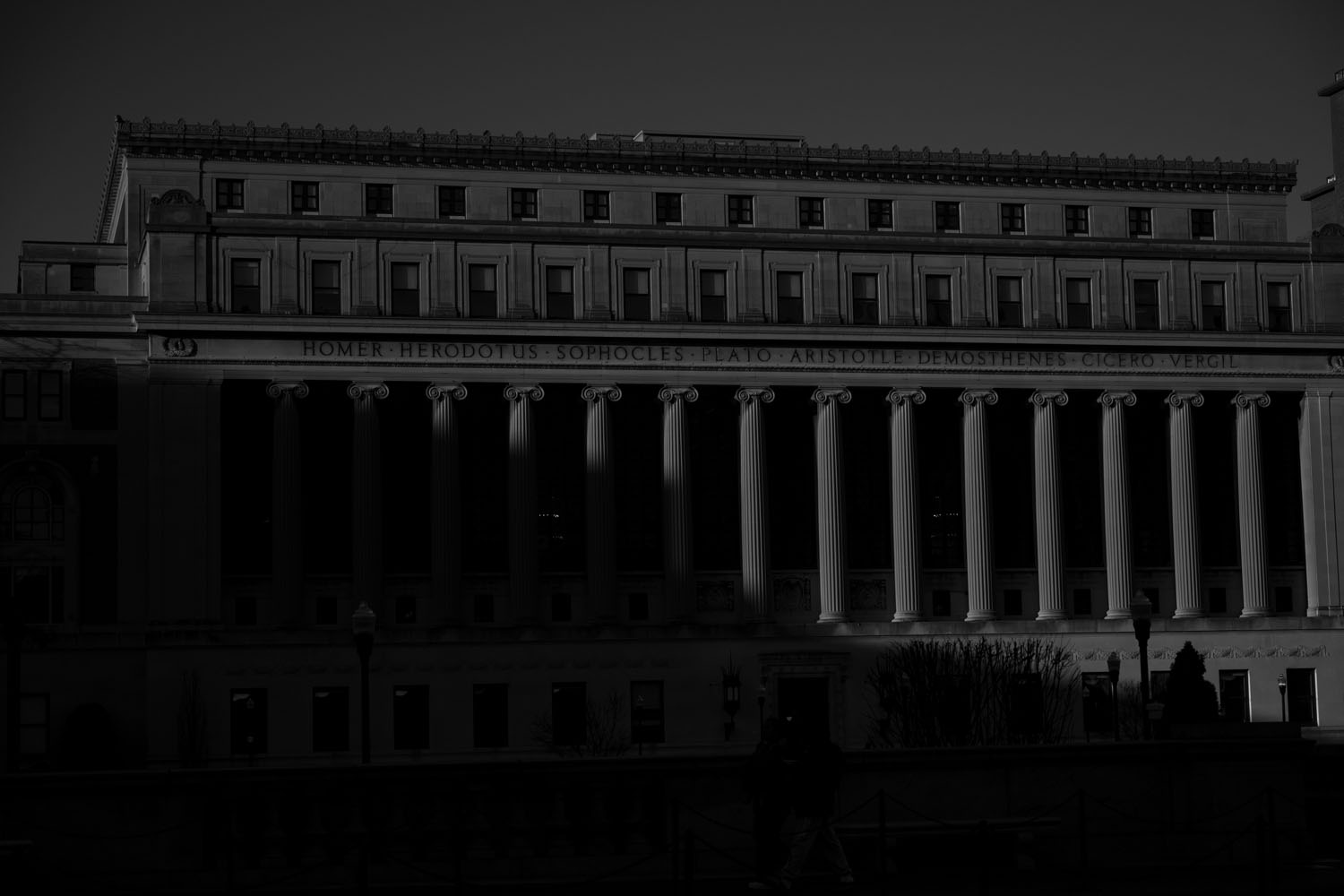
Bing Guan: New York Police officers in riot gear enter Hamilton Hall at Columbia University, New York, April 30, 2024
Mark Peterson is a photographer based in New York City. His work has been published in the New York Times Magazine, New York Magazine, The New Yorker, Time, Fortune, National Geographic, Geo Magazine and other national and international publications. In 2018 he was awarded the W. Eugene Smith grant for his work on White Nationalism. This photograph was published in The New York Times and selected as one of the "photos that defined 2024."
Bing Guan 管秉宸 is a Chinese American photographer and journalist. He is based between New York City and Southern California. He is currently an adjunct professor of photography at the Columbia Graduate School of Journalism. Bing is a regular contributor to Reuters, Bloomberg, and The New York Times.
July 10, 2025

Columbia University by Nina Berman
"For more than fifty years, I have been studying and writing about political repression and higher education, with a special emphasis on McCarthyism, long considered by historians to be the most serious assault on academic freedom since the emergence of the modern university. But, as Nina Berman’s photographs of Columbia University show, what has been happening to the American academy these days is incommensurably worse. Berman, who teaches in the journalism school at Columbia, has spent decades documenting protests and the like, and naturally did so again in 2024, when pro-Palestinian demonstrations unfolded on the campus where she teaches. In the year since, she has continued to photograph with an almost diaristic discipline, and has amassed a visual narrative of Columbia’s painful transformation. In these haunting images of a locked-down campus bristling with surveillance cameras and security guards, we see autocracy revealed in the form of a restive yet silent space under control. Because Columbia’s leaders have capitulated to the Trump administration, a once-proud citadel of higher learning and independent thought is losing its credibility." --click for full article
Related: Podcast - Nina Berman: A Lens on Consequence
Via Freedom Of The Press Foundation
Journalists covering recent demonstrations in California have been assaulted, detained, shot with crowd-control munitions, and had their equipment searched — simply for doing their jobs.
Freelance and independent reporters are especially vulnerable, yet they continue to document how immigration raids impact communities and how law enforcement responds to civil unrest. Some of the journalists joining us are also plaintiffs in lawsuits pushing back against police actions that threaten press freedom and violate the First Amendment.
Join us to hear their firsthand accounts and learn what it means to uphold the public’s right to know in the streets and on the front lines.
If you cannot attend, help protect the rights of these journalists and defend press freedom everywhere by making a donation to support our work at this link.
On July 9th, we’ll be joined by:
- Adam Rose, Press rights chair and secretary at LA Press Club
- Ben Camacho, Journalist and co-founder of The Southlander
- Sean Beckner-Carmitchel, Independent videographer
- Tina-Desiree Berg, Journalist for Status Coup and other outlets
- Caitlin Vogus, Freedom of the Press Foundation senior adviser
March 17, 2025
Her 9-minute video of George Floyd’s murder became undeniable proof, fueling a global movement and reinforcing the power of citizen journalism
Via Editor & Publisher
What happens when a city silences a newspaper? An inside look at the Clarksdale censorship case
February 21, 2025
The Associated Press sued three Trump administration officials Friday over access to presidential events, citing freedom of speech in asking a federal judge to stop the 10-day blocking of its journalists.
The lawsuit was filed Friday afternoon in U.S. District Court in Washington, D.C.
The AP says its case is about an unconstitutional effort by the White House to control speech — in this case refusing to change its style from the Gulf of Mexico to the “Gulf of America,” as President Donald Trump did last month with an executive order.
“The press and all people in the United States have the right to choose their own words and not be retaliated against by the government,” the AP said in its lawsuit, which names White House Chief of Staff Susan Wiles, Deputy Chief of Staff Taylor Budowich and Press Secretary Karoline Leavitt.
“This targeted attack on the AP’s editorial independence and ability to gather and report the news strikes at the very core of the First Amendment,” the news agency said. “This court should remedy it immediately.”
In stopping the AP from attending press events at the White House and Mar-a-Lago, or flying on Air Force One in the agency’s customary spot, the Trump team directly cited the AP’s decision not to fully follow the president’s renaming.
“We’re going to keep them out until such time as they agree that it’s the Gulf of America,” Trump said Tuesday.
This week, about 40 news organizations signed onto a letter organized by the White House Correspondents Association, urging the White House to reverse its policy against the AP.
February 14, 2025
White House press secretary Karoline Leavitt, who on Wednesday used the word “lies” in describing AP content, posted on X Friday afternoon about executive orders Trump had signed before his departure. She ended her post: “The @AP was not invited.”
Update February 15, 2025
February 11, 2025
Sponsored by Rep. Sarah Silva, D-Las Cruces, House Bill 153, or the Protect Reporters from Exploitative State Spying Act, proposes an update to New Mexico’s current shield law to cover the many ways reporters operate today. House Speaker Javier Martínez and Senate Majority Leader Peter Wirth are co-sponsoring the legislation.
A shield law is designed to protect journalists’ sources and communications, important in a world where powerful forces seek to intimidate reporters and stop them from doing their jobs.
The role of journalism — which has been part of The Santa Fe New Mexican’s 175-year legacy — is to be the public’s watchdog, to pay attention to accountability stories on behalf of the public. Shield laws effectively are in the public’s behalf.
Importantly, the legislation expands the definition of what a journalist is, taking into account how reporting takes place today.
A journalist might be a reporter for an established newspaper, a TV or radio station, a podcaster, an online news site, or an independent citizen covering the local school board in small-town New Mexico. These journalists deserve protection, a sentiment approved by the New Mexico Press Association, which voted to support this legislation Monday.
The communications of journalists also deserve to be kept confidential, so Silva’s bill would shield emails, for example, from state snooping. It is a comprehensive piece of legislation, put together after much research and consultation with experts.
Silva’s bill is similar to federal legislation that died in Congress in 2024, the federal PRESS Act. That law was modeled after regulations put in place by the U.S. Department of Justice under former President Joe Biden. Then-President-elect Donald Trump, however, told congressional Republicans to stop the federal PRESS Act. That leaves it to states to offer protections to reporters.
According to attorney Charles K. Purcell, New Mexico has had a law concerning a reporter’s privilege on the books, with an updated statute adopted in 1973. Purcell is an expert on the shield law in New Mexico and worked with Silva on drafting this legislation.
The New Mexico Supreme Court held the current law unconstitutional to the extent it regulated procedures in state court with its own rule of evidence. The current shield law and Silva’s legislation only will apply to proceedings in the legislative and executive branches.
Should there be an impeachment hearing in the House of Representatives, for example, a reporter’s notes naming a source could not become fodder in the proceedings. Similarly, attempts by agencies under the governor’s purview would be stymied if they targeted whistleblowers.
Despite ruling that the shield law does not apply to court proceedings, the New Mexico Supreme Court does have its own press shield rule, adopted in 1982. Journalists’ sources are protected in local and state courts — and Silva is in conversations with the Supreme Court to update that rule.
In a national atmosphere where journalists remain under attack by everyone from the president on down, ensuring reporters can work without fear of reprisal is important.
As Silva pointed out when she announced her legislation: “We see examples at the federal level of government chipping away at journalists’ ability to do their jobs by pursuing the identities of unnamed sources and deterring whistleblowing.
The integrity of unnamed sources is critical to journalists fulfilling their role as watchdogs in our society. I want to ensure New Mexico safeguards the integrity of journalism.”
January 30, 2025
Grieve The Loss Of Local Newspapers During Photojournalism Exhibition At Milwaukee Art Museum
Worse still, at the same time, 43,000 newspaper journalist jobs have been eliminated, nearly two-thirds! Imagine any other industry critical to American society, the American way of life, and American democracy losing two thirds of its workers in less than 20 years. There’d be congressional hearings. The president would address the nation with a bold plan to reverse the trend...
Why are politicians and the public not crying over these job losses? Because journalists–the good ones–hold the powerful to account. Politicians, corporations, the wealthy. The powerful benefit when newspapers close or reduce coverage. Citizens lose....
An exhibition on view through March 16, 2025, at the Milwaukee Art Museum demonstrates how photographers have understood and wielded the power of images to convey events. Through more than 100 objects, “True Story: Photography, Journalism, and Media,” offers a window into a bygone past of robust, objective, professional news coverage in America focused on the picture makers...
Filling the void left by the evisceration of newspapers has been partisan cable news commentators shrieking talking points 24/7/365, masquerading opinion as news, perspective as information, and, increasingly, social media."
By Hafsa Maqsood
December 10, 2025
Via Freedom Of The Press Foundation
December 5, 2024
November 18, 2024
TOPEKA — The editor of the Kansas newspaper raided by police last year has a message for journalists struggling with their sense of purpose.
Go on the offensive.
Eric Meyer, editor and publisher of the Marion County Record, delivered remarks Friday as he was inducted alongside his mother, Joan, into the Kansas Press Association Newspaper Hall of Fame.
“I think this is a time when we have to establish for the people of this country the fact that we are important, that we have things that we can tell them that they will want to know, that they will want to change their positions about,” Meyer said.
He added, in a nod to the results of the presidential election: “Let’s not make America great again. Let’s make democracy great again.”
Police raided the Marion County Record newsroom and the home where Meyer lived with his mother in August 2023 under the false pretense that journalists had committed a crime by looking up a public record. Joan Meyer, the 98-year-old co-owner whose profane clash with police officers was captured on camera, died a day after the raid from stress-induced cardiac arrest. The raid spawned five civil lawsuits and a criminal charge against the police chief who led the attack on a free press.
Meyer said he is “an odd duck” because he retired to run a newspaper, rather than retire from it. He returned to Kansas during the COVID-19 pandemic to take over the publication his parents had operated for decades. After teaching journalism for 20 years at University of Illinois at Urbana-Champaign, Meyer wanted to practice what he had been preaching — that journalism is still vital.
“We’re not talking about the future of journalists. We’re talking about the future of democracy,” Meyer said. “Because without journalism, there is no democracy. We can’t have an informed public making informed decisions that will lead our country if they don’t have information, solid information that’s reliable. Getting their attention, though, is a very serious problem.”
Via Columbia Journalism Review
October 7, 2024
Since the violence of last October 7—as the conflict between Israel and Palestine has grown deadlier, and spread more widely in the Middle East—it has also been, according to the US Press Freedom Tracker, a nonpartisan database of press freedom violations, a “protest year.” The visual journalists who cover demonstrations across America—photographers, videographers—are at the center of the action. “We have to get creative, go on the floor, shoot through cops’ legs, just to get that visual,” Madison Swart—a photojournalist in New York whose work has been published in Out and Cosmopolitan, among other places—told me. In May, while covering a pro-Palestinian protest, Swart was briefly detained by police officers—one of forty-three journalists who have been arrested in the past year, triple the previous number. According to Stephanie Sugars, a reporter for the US Press Freedom Tracker, “it has felt that the predominant number of incidents, at least since the protests started, are against people who are documenting visually in some capacity.”
September 21, 2024
"Photography radically acts as a language that speaks for the world’s oppressed and critically functions as a vital visual voice of resistance."
"Photography helps us understand what we are and imagine what we might become...
The fight for equality across the human condition radically evolves out of protest. Beyond the jackboots, the batons, the water cannon, the tear gas, the bullets, the tanks, the fences, the walls, the concentration camps and all means of surveillance, history teaches that what power fears more than anything is a people on the move against injustice. Looking at the history of photography, we can understand that progress across the political terrain of human rights has been difficult. Marginalized bodies, when divided, are vulnerable to capture, control and genocide. Thinking through our past in photographs and decentering the knowledge formations of imperial lenses means that we can critically join or remake the politics of the left intersectional, aligned in mission, and truly inclusive. This will create waves of solidarity and supportive modes of resistance that strategically enable people to embrace the different ecologies of freedom and resist imperialist politics that divide and rule" -- click for full article
August 27, 2024